
English


Views: 0 Author: Site Editor Publish Time: 2026-10-26 Origin: Site


Moving heavy materials across muddy, deeply rutted sites is a notorious challenge for any project manager. How do you lift heavy loads safely when the ground beneath your tires is uneven and unpredictable? A telescopic handler solves this logistical nightmare effortlessly. Acting as the ultimate hybrid machine, it seamlessly combines the forward reach of a crane with the brute lifting power of a traditional forklift.
Investing in the correct lifting equipment directly improves operational safety and drastically reduces manual labor expenses. By replacing several single-purpose machines through interchangeable hydraulic attachments, this equipment acts as a versatile multi-tool critical for every project phase—from initial site grading to final roofing installations.
Recent shifts in commercial and residential building have drastically altered equipment needs on the ground. With persistent skilled labor shortages, contractors are increasingly turning to modular construction and prefabricated structural components to accelerate project timelines. Moving these massive, pre-assembled wall panels requires highly adaptable lifting solutions.
Consequently, site managers are moving away from stationary, single-purpose machines. They now favor multi-functional fleets capable of handling dynamic loads across shifting site conditions. This macro-trend has cemented the telescopic boom lift as an indispensable asset, allowing crews to do more heavy lifting with fewer machines and smaller teams on site.
To truly understand the value of this equipment, one must look at its core engineering. Functioning essentially as a hybrid unit, a construction telehandler features a robust chassis paired with a highly capable telescopic boom. Powered by high-capacity hydraulic systems, these machines are built to move heavy loads over complex topographies where standard warehouse equipment would sink to its axles.
On a standard active site, project managers frequently face a logistical bottleneck between conventional forklifts and mobile cranes. Traditional masted forklifts are highly efficient but strictly limited to vertical lifting. They require flat, paved surfaces to operate safely. Conversely, mobile cranes offer exceptional reach and weight capacity. However, they are stationary, expensive to rent, and often represent massive overkill for moving standard pallets of bricks or lumber.
The telescopic handler fills this exact void. It provides the quick mobility of a forklift alongside the forward-reaching capabilities of a small crane. In practical terms, an operator can pick up a load of lumber from a delivery flatbed, drive it across an unpaved excavation zone, and place it precisely onto a third-story scaffold. All of this is done without ever needing to reposition the base machine.
Modern construction zones are frequently congested with personnel, scattered materials, and other heavy machinery. Navigating these tight spaces requires specialized steering. Most modern units come equipped with three distinct steering modes to handle severe spatial constraints.
Front-Wheel Steer: Ideal for driving on public roads or relatively flat, open pathways where standard vehicle handling is required.
Crab Steer: All four wheels turn in the same direction, allowing the machine to move diagonally. This is crucial when the operator needs to shift sideways away from a wall or trench without altering the machine's forward orientation.
Coordinated Four-Wheel Steer: The front and rear wheels turn in opposite directions, drastically reducing the turning radius. This mode is an absolute necessity for navigating tight corners in dense urban developments.
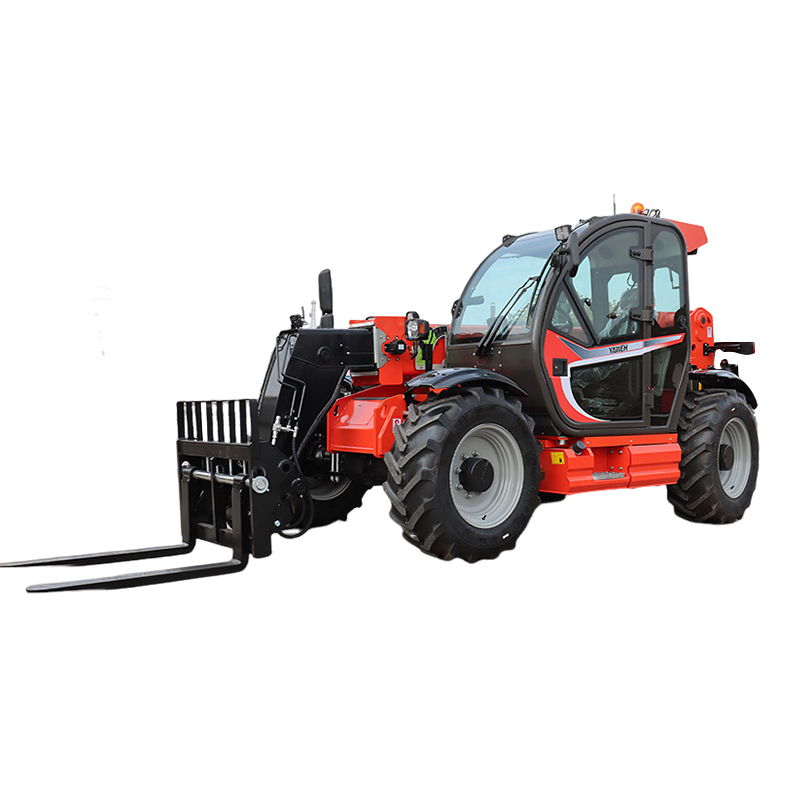
The true value of this equipment lies in its adaptability across varying phases of a build. By simply swapping the front attachment, crews can transition from foundation work to structural framing in minutes.
Masonry work demands a constant, heavy supply of bricks, cinder blocks, and mortar. Manual transport of these materials is agonizingly slow and poses severe ergonomic risks to workers. Equipped with standard pallet forks, the machine can lift heavy pallets of stone directly from delivery trucks and place them gently onto elevated scaffolding. By extending the boom, the operator places materials precisely where the masons are working, ensuring a continuous workflow and minimizing costly downtime.
During the structural framing phase, precision and brute power are paramount. Lifting steel I-beams, heavy wooden trusses, and prefabricated components requires a machine that can hold a heavy load steady at significant heights. The telescopic boom allows operators to thread beams into tight structural frameworks. Furthermore, with the addition of a lifting jib attachment, the machine acts as a mobile pick-and-carry crane. This provides the exact reach needed for multi-story framing without the exhaustive setup time required for a traditional crane.
Transporting roofing materials to the top of a structure is a high-risk task. Instead of workers hauling heavy shingles up a precarious ladder, an operator can gently boom up a full pallet right to the roof's edge. This application minimizes the risk of catastrophic material drops, significantly reduces worker fatigue, and accelerates the overall enclosure of the building envelope.
Before foundation work begins and long after the final nail is driven, the job site requires extensive material management. By swapping pallet forks for a heavy-duty material bucket, the unit transforms into a makeshift wheel loader. It can be aggressively used to scoop and transport gravel, backfill dirt into trenches, level uneven ground, and clear scattered construction debris into commercial dumpsters.
Selecting the correct machine is a critical procurement decision. Choosing the wrong specification can lead to safety hazards, decreased efficiency, or unnecessary rental costs. These machines are generally categorized by their chassis design, maximum lift capacity, and intended operating environment.
Construction sites are rarely flat or paved during the early stages of a project. Deep mud, loose gravel, severe ruts, and steep inclines are standard operating conditions. A Rough Terrain Telehandler is engineered specifically to conquer these harsh environments. For instance, the T735 model is built for aggressive off-road material handling. It features deep-tread pneumatic tires that provide maximum traction and high ground clearance to avoid bottoming out on debris. When deployed, front axle stabilizers widen the machine's footprint, shifting the center of gravity and allowing the operator to lift heavier loads safely on uneven ground.
For industrial construction, mining support, and large-scale commercial projects, standard lift capacities simply fall short. A Heavy Duty Telehandler is designed to lift extreme weights. The T1840 model exemplifies this category, offering massive structural reinforcements, oversized hydraulic cylinders, and a heavy counterweight system. These specialized units are the go-to choice when moving large precast concrete blocks, massive structural steel components, or heavy industrial machinery.
For residential builds and tight urban job sites, compact and standard models are ideal. In scenarios requiring significant vertical reach without a massive footprint, a 3.5-Ton 9.5m Telescopic Telehandler provides the optimal balance. Models like the T935 deliver a 3.5-ton lift capacity combined with a 9.5-meter reach, making them perfect for threading materials into second or third-story scaffolding while still being able to navigate narrow access gates.
| Model Type | Typical Lift Capacity | Key Engineering Features | Ideal Application Scenario |
|---|---|---|---|
| T735 Rough Terrain | 3.5 Tons | High ground clearance, deep-tread tires, 4WD | Muddy, unpaved early-stage construction sites |
| T935 Standard Reach | 3.5 Tons | 9.5m boom extension, compact turning radius | Residential framing, multi-story masonry scaffolding |
| T1840 Heavy Duty | High Capacity | Reinforced high-yield steel boom, oversized hydraulics | Industrial precast concrete, heavy steel erection |
The return on investment of a telescopic handler is directly tied to its attachments. A standard quick-hitch system allows operators to change attachments in mere minutes, transforming the machine's primary function entirely.
Pallet Forks: The most common attachment, engineered specifically for lifting palletized goods, lumber, and block. Fork spacing can usually be adjusted manually or hydraulically to accommodate diverse load widths.
Material Buckets: Available in various capacities, buckets are used for scooping loose aggregate, sand, and site waste. While it can act as a loader, it is best used for loose materials rather than hard digging.
Lifting Jibs and Winches: These attachments convert the machine into a mobile crane. They are strictly used for suspending loads that cannot be palletized, such as pipes or structural steel.
Work Platforms: Safety is an absolute priority when elevating personnel. A specialized man basket attachment allows workers to be lifted safely for tasks like painting, welding, or high-level maintenance, utilizing the machine's built-in safety interlock systems.
To make an informed procurement decision, project managers must weigh the operational advantages against the inherent limitations of the equipment.
Purchasing or renting one machine that can perform the duties of a forklift, a small crane, and a skid steer significantly reduces fleet size and maintenance costs. Furthermore, modern models are equipped with Load Moment Indicators, known as LMI, and advanced load management systems. These onboard computers monitor the boom extension, angle, and load weight in real-time. They automatically lock out hydraulic functions if the machine approaches its tipping point, which drastically accelerates productivity while maintaining stringent safety protocols.
Despite their versatility, these machines require a higher initial capital investment compared to standard masted forklifts. Size and footprint can also be a limiting factor. Most importantly, operating a telescopic boom introduces complex physics. Operators must undergo specialized certification to understand how to read load charts accurately. A load that is safe to lift close to the chassis may cause the machine to tip if extended horizontally.
Selecting the right specifications is only half the equation; the origin of the equipment is equally important. The construction industry operates on strict deadlines, and equipment failure can lead to cascading delays and severe financial penalties. Therefore, sourcing your fleet from a reputable telehandler manufacturer is a strategic business decision that heavily influences your long-term return on investment.
Construction sites are unforgiving environments. Equipment is subjected to heavy vibrations, abrasive dust, moisture, and continuous heavy lifting. A top-tier manufacturer utilizes high-grade, high-tensile steel for the boom and chassis construction, ensuring the structural integrity of the machine under maximum stress. Premium manufacturers also invest heavily in precision-engineered hydraulic pumps, heavy-duty cylinders, and leak-resistant hoses to prevent premature metal fatigue.
Partnering with an established manufacturer ensures immediate access to comprehensive after-sales support, robust inventory levels of spare parts, and clear warranty terms. Sourcing attachments directly from the original manufacturer guarantees seamless integration, ensuring that the machine's load management software accurately reads the weight and maintains strict safety standards.
The telescopic handler has proven itself to be the vital backbone of modern construction material handling. It provides unmatched reach, capacity, and versatility, effectively bridging the gap between traditional forklifts and expensive mobile cranes. Choosing the right machine ensures project success, whether you rely on a rough terrain model to navigate deeply rutted mud or deploy a heavy-duty unit to manage massive steel frameworks safely.
Always take the time to match the equipment specifications and attachments precisely to your site's application. If you are looking to upgrade your material handling fleet with machinery engineered for durability and precision, explore the full range of specialized equipment at YAWEH to find the exact model that fits your project demands.
The primary difference lies in the lifting mechanism and terrain capability. A standard forklift uses a vertical mast, limiting it to lifting loads straight up and down, and is typically designed for flat, smooth surfaces like warehouse floors. A telehandler utilizes a telescopic boom, which allows it to extend loads both vertically and horizontally. Additionally, they are built with robust chassis, four-wheel drive, and specialized tires, enabling them to operate effectively on rough, unpaved construction terrains.
Yes, in almost all jurisdictions, operating this equipment requires specialized certification. Because the machine features a telescopic boom, the center of gravity shifts dynamically as the load is raised and extended. Operators must be formally trained to read and interpret complex load charts, understand the strict limits of the machine's stability, and properly utilize safety features like frame leveling and outriggers.
For light to medium lifting tasks, yes. Units equipped with lifting jibs or winches can easily replace small mobile cranes for tasks like placing roof trusses, lifting pallets of bricks, or positioning small steel beams. They offer the added benefit of high mobility and significantly faster setup times. However, for massive structural lifts or extreme heights, a dedicated crane remains a strict engineering requirement.
Rough terrain models are specifically engineered for the unpredictable environments of active construction sites. They feature heavy-duty off-road tires, powerful four-wheel-drive systems, and higher ground clearance to navigate over debris and mud. Crucially, they also include stability enhancements such as hydraulic frame leveling, which allows the operator to keep the chassis perfectly flat on a slope.
The lifting capacity depends entirely on the machine's engineering specifications. Compact and standard models typically manage loads between 2.5 to 3.5 tons. In contrast, heavy-duty models feature reinforced booms, larger counterweights, and uprated hydraulic systems, allowing them to safely lift anywhere from 4 tons up to 10 tons or more. It is vital to remember that this maximum capacity only applies when the boom is fully retracted.
Stability on uneven ground is achieved through a combination of hydraulic frame leveling and deployable outriggers. The frame leveling system allows the operator to tilt the chassis independently of the axles, keeping the main body level even if the tires are on a slope. For heavy lifts, dropping the front outriggers widens the machine's footprint, anchoring it firmly to the ground and preventing lateral tipping.
Modern units rely heavily on Load Moment Indicators. This onboard computer system continuously calculates the weight of the load, the boom angle, and the extension length. If the operator attempts to push the load beyond the safe working envelope, the system will automatically lock out the hydraulics, preventing the boom from extending further and saving the machine from a rollover.


