
English


Views: 0 Author: Site Editor Publish Time: 2026-10-14 Origin: Site


Picture a sprawling commercial construction site after a heavy spring rain. Mud is everywhere. Deep ruts make moving materials nearly impossible for standard lifting equipment. Standard warehouse forklifts often fall short on these compromised, rough terrains. When you need to move heavy loads not just vertically, but forward and over physical obstacles, you need a highly specialized asset.
Enter the telehandler. By combining the straightforward lifting capabilities of a traditional forklift with the extended reach of a small crane, this equipment has become the ultimate hybrid workhorse. Whether you are managing a large-scale agricultural operation or a complex commercial build, understanding the specific uses and mechanical limits of this machinery is crucial for making a sound investment.
In this comprehensive guide, we will explore exactly what these machines are used for, dissect their core mechanical advantages, and provide actionable tips for selecting the right model for your fleet.
Unmatched Versatility: Thanks to a quick-attach system, a single machine functions as a multi-purpose tool. It easily swaps between pallet forks, material buckets, and aerial work platforms.
Superior Reach and Terrain Adaptability: Unlike standard vertical-mast forklifts, these machines can lift loads forward and upward while effortlessly navigating rough, uneven terrains.
Industry-Wide Application: They remain indispensable in commercial construction, large-scale agriculture, and outdoor industrial warehousing for heavy material handling.
Smart Purchasing Decisions: Choosing the right equipment requires evaluating dynamic lift capacities, maximizing reach height, and partnering with a reputable supplier for long-term reliability.
To truly grasp the value of this equipment, we must look under the hood at its mechanical foundation. A Telescopic Material Handler is engineered to bridge the gap between a traditional forklift and an articulated crane. It offers unique logistical advantages in material placement.
The term telehandler is a simple portmanteau of telescopic and handler. The telescopic portion refers directly to the machine's defining architectural feature. This is a hydraulic boom consisting of nested steel sections that can stretch outward and upward, much like a spyglass. The handler portion denotes its primary function of heavy material transport. Unlike standard vertical-mast units confined to lifting loads straight up and down, the telescopic boom empowers operators to place materials over perimeter walls, across deep foundation trenches, or onto elevated scaffolding without repositioning the vehicle base.
Operating on fundamental principles of high-pressure hydraulics and counterbalanced physics, the machine requires a careful orchestration of several core components. For instance, a robust rough-terrain model typically features a 74kW turbocharged engine paired with a four-wheel-drive system. This power plant ensures a 3,500 kg maximum lift capacity up to 7 meters in height, allowing for seamless operation in the harshest environments.
The Telescopic Boom: Forged from high-yield-strength steel, the boom utilizes massive hydraulic cylinders to push nested sections outward for extension and pull them back in for retraction. Under heavy loads, a slight, engineered deflection in the boom is normal and expected.
The Chassis and Counterweight: The heavy-duty steel chassis provides a deliberately low center of gravity. A substantial cast-iron counterweight sits at the rear. This acts as the primary anchor to prevent tipping when a heavy pallet is extended over the front axle.
The Hydraulic System: A high-capacity variable displacement pump drives pressurized fluid to the boom cylinders, steering mechanisms, and attachment controls. This system provides the immense, smooth force required to manipulate thousands of pounds with pinpoint accuracy.
Stabilizers and Outriggers: Many heavy-duty models feature deployable front stabilizers. When driven into the ground, these outriggers shift the machine fulcrum point forward and widen its footprint. This drastically increases lifting capacity and stability at maximum extension.
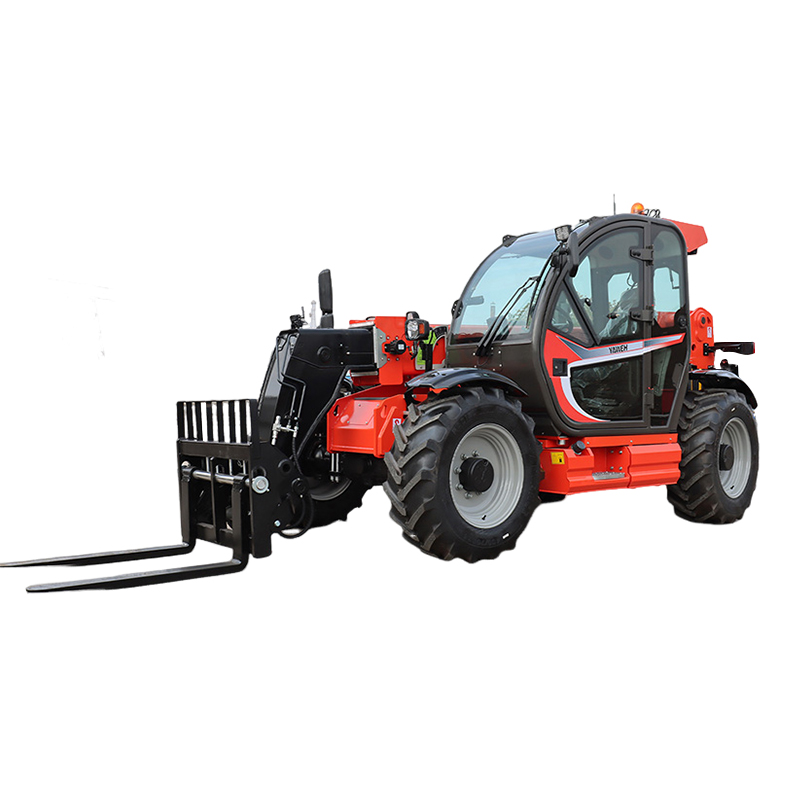
The core question for any equipment buyer is how the specifications on paper translate to real-world profitability. The inherent versatility of this machinery allows it to serve as the primary logistical backbone across multiple demanding sectors.
In commercial and residential construction, the speed at which materials are staged directly dictates the project timeline. Site managers primarily deploy these machines to transport palletized loads of bricks, cinder blocks, steel I-beams, and roofing shingles from delivery flatbeds directly to elevated work zones.
Instead of relying on exhausting manual labor or paying exorbitant daily rates for a tower crane, a contractor can seamlessly place a pallet of lumber directly onto a third-story framing deck. Furthermore, construction sites are notorious for mud, loose gravel, and debris. Equipped with four-wheel drive and deep-tread pneumatic tires, these units ensure that heavy payloads traverse compromised surfaces without losing vital traction.
Modern agricultural operations handle massive daily volumes of feed, livestock waste, and harvested crops. In this environment, a telescopic boom is often considered vastly superior to a standard farm tractor equipped with a front-end loader. This is largely due to its horizontal reach and superior lift height.
Picture a sprawling dairy farm during the peak of harvest season. Farmers utilize these units for stacking large, high-density hay bales deep inside storage barns, where optimizing vertical space is critical. The forward reach allows operators to stack bales higher and deeper into the barn without driving the tires dangerously close to the stack. Specifically, they are used for loading silage into high-sided feed mixers, mucking out deep-litter livestock enclosures, and transporting one-ton bulk fertilizer bags.
While standard cushion-tire forklifts dominate the smooth, polished concrete of indoor warehouses, telescopic handlers take command in outdoor industrial applications. Lumber yards, steel pipe manufacturing facilities, and municipal recycling plants often feature unpaved storage yards. They require materials to be stacked in dense, deep rows.
In these challenging environments, the machine can reach completely over the first row of stacked lumber to retrieve a load from the second or third row. Consequently, this horizontal reach capability allows industrial facilities to design much denser storage layouts. It maximizes their available square footage without needing to carve out wide driving aisles for standard forklift maneuvering.
A bare machine without an attachment is simply a powerful boom on wheels. The true utility—and the secret to its high return on investment—lies in the quick-attach carriage system. This allows operators to swap out front-end implements to suit highly specific tasks.
By utilizing different attachments, a single unit effectively performs the jobs of a rough-terrain forklift, a wheel loader, and an aerial man-lift.
| Attachment Type | Primary Function | Ideal Industry Application |
|---|---|---|
| Standard Pallet Forks | Lifting and moving palletized goods, lumber, and block materials. | Construction, Outdoor Warehousing |
| Material Buckets | Scooping, transporting, and dumping loose materials like gravel, dirt, snow, or grain. | Agriculture, Landscaping, Mining |
| Aerial Work Platforms | Safely elevating personnel and their tools for high-level maintenance or installation. | Facility Maintenance, Utilities |
| Bale Spears and Clamps | Piercing or gripping large round or square hay bales for transport and high stacking. | Agriculture, Farming |
| Sweepers and Brooms | Clearing debris, mud, and dust from paved job sites or large warehouse floors. | Industrial Cleanup, Roadwork |
Facility managers and procurement officers often debate whether to invest in a standard heavy-duty forklift or a telescopic unit. While both handle materials, their engineering philosophies, mechanical capabilities, and optimal operating environments differ drastically.
The most defining difference is the mechanical method of lifting. A standard forklift utilizes a vertical mast, restricting it to lifting loads strictly on a vertical Y-axis. If an operator needs to place a pallet onto a shelf, they must drive the machine front tires directly up to the base of that shelf.
In contrast, a telescopic boom introduces the X-axis. It can lift vertically, but more importantly, it extends horizontally. This forward reach allows the operator to load a flatbed truck entirely from one side. It also allows them to deliver framing materials over a physical barrier, such as a perimeter security fence or an open foundation trench.
Standard industrial forklifts are typically equipped with solid polyurethane or cushion tires and feature very low ground clearance. They are engineered exclusively for smooth, level concrete floors. Taking a standard warehouse forklift onto a muddy job site will almost certainly result in the machine sinking to its axles.
Conversely, telescopic handlers are purpose-built from the ground up for harsh environments. They feature high ground clearance to pass over rocks and ruts. They also utilize foam-filled or pneumatic tires boasting deep agricultural treads for maximum traction. Moreover, they offer advanced steering modes. Standard front-wheel steer is used for road travel. Four-wheel steer provides incredibly tight turning radiuses. Crab steer allows all four wheels to point in the same direction, enabling the machine to slide diagonally away from walls or obstacles.
Selecting the correct equipment requires a precise understanding of your operational environment and the physical demands of the materials being moved. These are not universally applicable assets. They are engineered into distinct categories based on chassis dimensions, boom length, and hydraulic lifting capacity.
The industry generally divides these material handlers into three primary categories. Each is engineered to solve specific logistical challenges.
Compact Telehandlers: Designed for supreme maneuverability in confined spaces, compact models feature a lower profile. This allows them to navigate through standard commercial garage doors, shipping containers, and tight barn aisles. Highly favored in agricultural settings and municipal maintenance, their lift capacities generally range from 1,800 to 2,700 kg, with maximum lift heights hovering around 5 to 6 meters.
Heavy-Duty and High-Capacity Telehandlers: When the operational requirement involves moving massive physical weight—such as large steel aggregates, heavy precast concrete blocks, or industrial machinery—heavy-duty models are mandatory. Built with reinforced chassis, heavy-duty axles, and high-displacement hydraulic cylinders, they prioritize raw lifting power over extreme vertical reach. They typically handle loads between 4,500 and 6,800 kg.
Long Reach Telehandlers: For multi-story construction, roofing projects, and wind farm installations, vertical and horizontal extension is the primary metric of value. For these specialized applications, a long reach telehandler provides the necessary boom extension to deliver materials directly to elevated scaffolding or upper-floor drop zones. Models in this tier often deliver an impressive 18-meter maximum lifting height and a 4,000 kg load capacity. Utilizing multi-stage booms, they offer exceptional height. However, operators must strictly adhere to load charts, as the maximum weight capacity decreases significantly at full extension.
As industrial demands shift, the equipment manufacturing sector is rapidly evolving. A noticeable trend in the material handling market is the integration of advanced telematics and Internet of Things sensors. Fleet managers are increasingly utilizing real-time data to track fuel consumption, monitor hydraulic health, and prevent catastrophic breakdowns before they occur.
Furthermore, stringent safety regulations have pushed manufacturers to implement smarter load management systems. Modern units now feature dynamic load moment indicators. These sensors automatically lock out the boom extension if the operator attempts to push a heavy load beyond the safe tipping point. Additionally, as environmental regulations tighten, the industry is seeing a steady transition toward hybrid and fully electric models. This shift is particularly evident in the compact tier, allowing for zero-emission operation inside enclosed warehouses and agricultural facilities without sacrificing hydraulic power.
Capital equipment investments require a balanced, objective assessment of how a machine will impact operational efficiency versus the logistical challenges it may inadvertently introduce.
The primary operational advantage is hybrid functionality. By combining the vertical lift of a forklift, the forward reach of a crane, and the scooping ability of a wheel loader, businesses dramatically reduce their overall fleet size. This consolidation leads directly to lower routine maintenance costs, reduced insurance premiums, and far less logistical headache when transporting equipment between job sites. Their rugged off-road capability ensures that expensive project timelines do not halt due to inclement weather or degraded site conditions.
Despite their immense versatility, these machines possess inherent physical limitations. First is the operational footprint. They are significantly larger, wider, and heavier than standard industrial forklifts. This makes them entirely unsuitable for densely packed, narrow-aisle indoor warehousing. The side-mounted boom placement also creates visibility blind spots on the right side of the cab, often requiring the use of ground spotters or advanced camera systems.
Secondly, the complexity of the machine introduces stricter training requirements. Because the center of gravity shifts dynamically as the boom raises and extends, operators cannot simply rely on a standard forklift license. They must undergo specialized certification to understand hydraulic limits, interpret complex load charts, and prevent lateral tipping.
Procuring heavy machinery is a decade-long commitment. The final purchasing decision should be based on empirical site data, weight requirements, and the structural reliability of the equipment provider.
The most critical step in the procurement process is analyzing the specific load chart of the machine. A common, and potentially dangerous, misconception is that a machine rated for 4,000 kg can lift that full weight to its maximum height or furthest forward reach. Due to the immutable laws of leverage, this is physically impossible.
As the boom extends horizontally away from the chassis, the center of gravity shifts forward. A machine that easily lifts 4,000 kg when the boom is fully retracted may only safely support 800 kg when fully extended. Buyers must calculate their worst-case scenario lift. Identify the heaviest material you need to move and the furthest horizontal distance it must be placed. Then, ensure the chosen load chart accommodates that exact intersection.
Specifications on a glossy brochure are only as valuable as the engineering and after-sales support backing them. Equipment downtime on a commercial site translates directly into thousands of dollars in lost daily revenue.
Sourcing your equipment from a reputable telehandler manufacturer ensures that you receive comprehensive support. This includes accessible warranties, robust engineering featuring certified Roll-Over and Falling Object Protective Structures, and immediate replacement parts availability. A trusted manufacturer provides transparent load charts, comprehensive maintenance manuals, and intelligent chassis designs that prioritize easy access to hydraulic hoses and engine filters. This drastically reduces the labor hours required for routine servicing.
A telehandler conquers heavy loads and rough terrain with ease, bridging the gap between traditional forklifts and heavy-duty cranes. By mastering both vertical lift and horizontal reach, it stands as one of the most versatile pieces of equipment on any modern job site.
Before making an investment, meticulously evaluate your site requirements. Map out your maximum lift heights, assess your heaviest material loads, and account for the terrain your operators will face daily. Choosing the right machine configuration not only accelerates project timelines but significantly boosts your long-term return on investment. If you are ready to upgrade your fleet, visit https://www.yawehbackhoe.com to explore a full range of robust material handling solutions engineered to lighten your heaviest burdens.
It is a portmanteau of telescopic and handler. The name refers directly to its extending hydraulic boom, which functions like a telescope, and its primary operational purpose of heavy material handling across varied job sites.
While it can lift suspended loads using a specialized jib or hook attachment, it is not a traditional crane. Operators must follow strict load chart guidelines and utilize ground stabilizers to ensure safety and prevent tipping during suspended lifts.
Yes, due to the complex load dynamics and constantly shifting center of gravity. Operators typically require specific telescopic handler certification, which is legally and operationally distinct from a standard warehouse forklift license.
A telehandler is designed primarily to lift heavy materials using forks, buckets, or grapples. In contrast, a boom lift—often called an aerial work platform—is engineered specifically and exclusively to lift personnel safely for elevated work.
Capacities vary widely by specific model, ranging from 1,800 kg for compact units to over 6,800 kg for heavy-duty models. However, it is crucial to remember that the maximum safe lifting capacity decreases significantly when the boom is fully extended horizontally.
Rental rates depend on the lifting capacity and boom reach, typically ranging from a few hundred dollars a day to several thousand dollars a month. Purchasing a new unit is a major capital investment, varying greatly based on engine power, maximum reach, and included attachments. Used models offer a lower barrier to entry but require careful inspection of the hydraulic systems.
While most models are equipped with road-travel steering modes and lights, they are generally not designed for long-distance highway travel. They have low top speeds and lack standard highway safety features. They are legally permitted to travel short distances between adjacent job sites or farm fields on public roads, provided they follow local municipal traffic regulations and display slow-moving vehicle signage.


