
English


Views: 0 Author: Site Editor Publish Time: 2026-10-22 Origin: Site


Ever fought with a heavy pallet on a chaotic job site? Picture wrestling two tons of roofing shingles onto a slick, third-story ledge. Now add deep mud and a rutted staging area to the mix. Standard vertical-mast forklifts simply bog down or tip over in these conditions. An extendable boom machine solves this exact headache. It delivers hydraulic muscle with unmatched horizontal and vertical flexibility.
But exactly how high can these rigs push a load? We need to look past the marketing brochures. In this guide, we break down real-world lift heights. We will explore the critical physics between boom extension and safe working loads. Grasping these mechanics ensures you put the right iron on your site.
Average Reach: Standard models typically reach between 19 and 55 feet, while specialized high-capacity machines can exceed 70 feet.
The Sweet Spot: A 31-foot reach remains one of the most versatile and popular sizes for mid-level construction and agricultural tasks.
Height vs. Capacity: Maximum lift height never equals maximum load capacity. Understanding the working envelope is crucial for safe operation.
Unmatched Versatility: With the right attachments, this equipment easily replaces rough terrain forklifts, small cranes, and elevated work platforms.
When project managers spec out machinery, the absolute maximum lift height is usually the first number they check. Yet, buying strictly based on peak height is a rookie mistake. Vertical reach depends entirely on chassis weight, boom stages, and hydraulic power. The heavy equipment industry categorizes these machines into three distinct tiers to help operators match the iron to the mission.
Understanding these classifications prevents you from overpaying for unnecessary reach or under-equipping your crews.
Compact Models: Built for low-clearance parking garages and tight agricultural barns. They reach about 13 to 19 feet. They handle roughly 3,000 to 5,500 pounds. Their low center of gravity makes them nimble, but their vertical stretch caps out at a single story.
Standard Models: The absolute workhorses of commercial masonry and framing. They punch up to 20 to 55 feet. A skilled operator can smoothly land heavy material stacks onto fourth-story scaffolding.
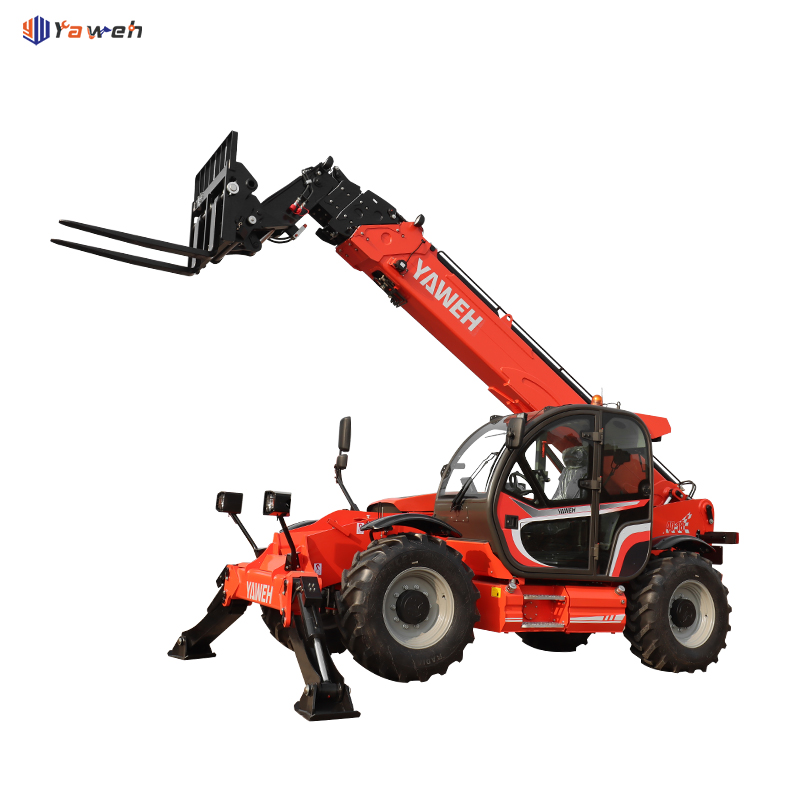
Long Reach Models: Designed for wind farm maintenance and heavy industrial steel erection. A true long reach telehandler utilizes a multi-stage reinforced boom and heavy-duty outriggers. These beasts easily exceed 60 feet, maintaining absolute stability at extreme elevations.
For a vast majority of general contractors and large-scale farmers, a machine that reaches around 31 feet represents the optimal balance of power, footprint, and operational cost. This configuration is widely considered the industry standard across multiple trades. It provides more than enough vertical extension to load flatbed trailers, stack high-density hay bales in tall barns, and reach two-story rooflines. Furthermore, it remains compact enough to navigate congested sites without requiring oversized transport permits.
Pushing heavy equipment to its absolute limits requires respecting physics. The most critical skill for any operator is reading the working envelope. This is the three-dimensional space where the boom travels. Weight limits shift drastically depending on where the forks are positioned inside that space.
A dangerous misconception frequently kills equipment and endangers crews. People assume a 10,000-pound rated machine can push that full weight to its ceiling. Physics dictates otherwise. This equipment operates on the principle of a lever, with the front axle acting as the primary fulcrum. As the hydraulic arm pushes higher and further out, the load's center of gravity shifts violently forward.
Lifting maximum capacity to maximum height invites a catastrophic forward tip-over. Consequently, manufacturers map out a decreasing safe working load. An 8,000-pound base capacity machine might shrink to a mere 2,000 pounds at peak elevation.
These machines offer a distinct mechanical advantage over standard warehouse forklifts because they extend horizontally. This capability changes the lifting dynamics entirely.
Vertical Lift: Booming up at a steep angle, like 60 to 70 degrees. The weight stays safely anchored over the chassis. You retain most of your native lifting power.
Forward Reach: Booming out horizontally to clear a muddy trench or a retaining wall. This destroys your lifting capacity. The weight moves far from the fulcrum point, multiplying the tipping force exponentially.
Every unit comes equipped with a specific load chart mounted inside the cabin. Reading this chart accurately is mandatory. Rather than guessing, operators must follow a strict protocol.
First, determine the exact weight of the material, including the pallet and the heavy metal attachment. Next, check the boom angle indicator inside the cab. Telescopic booms have visible, color-coded markers labeled A, B, C, or D that show how far the arm is currently extended. Finally, locate exactly where the boom angle and the extension zone intersect on the chart. That specific block displays the maximum safe weight. If the load exceeds that number, you must retract the boom, reposition the chassis closer to the target, or reduce the physical load weight.
Site managers often debate between an extendable boom and a traditional rough terrain forklift. Both chew through mud effectively. However, their structural mechanics dictate completely different optimal use cases. Understanding these nuances is critical for site efficiency.
A standard rough terrain forklift uses a straight vertical mast. It lifts straight up and straight down. Top heights usually hover around 15 to 22 feet. They hold their rated capacity well because the load stays tight against the carriage. However, they offer zero forward reach.
In contrast, a Telescopic Material Handler pushes loads up and over obstacles. Need to land drywall through a third-story window across a muddy ditch? A vertical mast cannot help you. An extendable boom is the only safe tool for the job. Models in the 7-ton class offer massive breakout force while still providing that crucial horizontal placement.
Rough terrain forklifts rely purely on their static counterweight. If you lift high on a slight slope, your margin for error vanishes entirely.
Extendable boom rigs feature active frame leveling. The operator can hydraulically tilt the entire chassis left or right up to 10 degrees. This keeps the boom perfectly plumb even if the tires sit on a rutted hillside. Additionally, high-reach models utilize front outriggers, drastically widening the base and anchoring the machine to the earth.
The material handling landscape is shifting rapidly. Urban job sites are shrinking, leaving zero room for sprawling crane setups. Consequently, contractors demand machines with compact footprints that deliver extreme vertical reach. We are seeing a massive transition toward high-reach units that can perform the duties of a small mobile crane without the extensive setup time.
Job site safety regulations are also driving technological upgrades. The days of relying solely on a printed load chart and operator intuition are fading. Modern heavy equipment now integrates smart load-moment indicators. These digital systems track boom angle, hydraulic pressure, and extension in real-time. If an operator attempts to boom out too far with a heavy pallet, the onboard computer automatically locks out the hydraulic functions. This prevents the machine from breaching its safe working envelope, drastically reducing tip-over incidents across the construction sector.
Buying or renting the right iron means matching your worst-case scenario lift to the machine's load chart. Under-sizing leads to dangerous workarounds, while over-specifying burns capital.
Let us look at actual engineering parameters. A compact 3.5-ton machine is perfect for residential framing. A 9.5m Telescopic Handler hits that exact sweet spot. It gives you roughly 31 feet of vertical stretch. It easily clears two-story rooflines while remaining light enough to haul on a standard tag trailer.
Conversely, heavy industrial sites require massive counterweights and multi-stage booms. If you are setting steel beams, you need a high-capacity unit. An 18-meter class machine gives you nearly 60 feet of reach, allowing you to bypass small cranes entirely.
| Equipment Class | Typical Lift Height | Base Capacity | Best Application |
|---|---|---|---|
| Compact | 13 - 19 feet | 3,000 - 5,500 lbs | Agriculture, Parking Garages |
| Mid-Range | 20 - 40 feet | 6,000 - 9,000 lbs | Residential Framing, Masonry |
| Heavy-Duty | 40 - 55 feet | 10,000 - 12,000+ lbs | Commercial Construction, Mining |
| Long Reach | 60+ feet | Varies (High Stability) | Wind Farms, Steel Erection |
Never forget to subtract the attachment weight. Swapping standard forks for a heavy-duty grapple bucket instantly eats up hundreds of pounds of your net lifting capacity. Attachments also push the load center further forward, altering the physics of the lift. You must consult a separate, attachment-specific load chart before booming up.
Hoisting tons of material into the sky is inherently dangerous. Respecting the load chart is step one, but environmental factors dictate the rest of the lift. As the arm extends, the machine becomes highly susceptible to tipping if strict safety protocols are ignored.
For high-reach operations, front outriggers are non-negotiable. These hydraulic legs shift the pivot point forward, transferring the immense weight off the front tires and directly into the earth. This single action exponentially increases your forward reach and maximum lift capacity. Always use wide dunnage pads if the soil looks soft or sandy.
A fully extended boom acts like a massive sail. High winds create dynamic side-loading that can easily flip a machine. Most sites halt high lifts when winds exceed 20 mph. Additionally, check your ground bearing pressure before booming up. If a front tire sinks into a hidden mud pocket while a load is 40 feet up, the lateral shift happens faster than an operator can react.
The defining characteristic of this machinery is its adaptability. By simply swapping the front attachment, the machine seamlessly adapts to various heavy-duty industrial demands.
In commercial and residential construction, these machines act as highly mobile cranes. They are routinely used to lift pallets of shingles directly to rooflines, eliminating hours of backbreaking manual labor. With a truss jib attachment, they can set wooden roof trusses or steel I-beams into place for welders. Their ability to drive through unpaved construction sites and immediately reach up to 55 feet makes them indispensable.
Modern agricultural environments require equipment that can handle bulky materials in tight spaces. Farmers utilize mid-size models to stack large round hay bales inside barns, often reaching heights of 30 feet to maximize vertical storage space. Equipped with a high-capacity bucket, they easily load grain into tall silos or transfer heavy loads of wet compost across rutted fields.
Extendable boom machines deliver incredible versatility, bridging the gap between standard forklifts and mobile cranes. Mastering their capabilities requires a strict adherence to physics, load charts, and site conditions. Remember, maximum height always comes at the cost of maximum capacity.
By evaluating your exact lifting heights, forward reach requirements, and terrain, you can select the perfect machine. Analyze your heaviest lifts and match them to rigorous engineering standards. For contractors needing reliable, high-performance machinery, exploring the full lineup of YAWEH equipment ensures you get the exact reach, breakout force, and capacity your job site demands.
Yes. As the telescopic arm extends higher and further away from the machine's center of gravity, the maximum safe lifting capacity decreases due to leverage and physics. A machine that lifts 10,000 lbs at ground level may only safely lift 2,500 lbs at its maximum height. Always consult the specific load chart inside the cab for exact figures.
There is no functional difference. These are simply different industry terms for the exact same piece of equipment. Depending on the region or industry, they are also commonly referred to as a reach forklift, a boom lift forklift, or a material handler.
Absolutely. These machines are engineered specifically for off-road environments. Most models feature full-time four-wheel drive, three distinct steering modes, aggressive pneumatic tires, and high ground clearance to effortlessly navigate mud, gravel, and uneven dirt.
If you push the machine beyond its rated capacity for a specific boom angle, the rear tires will begin to lift off the ground, signaling an imminent forward tip-over. Modern machines are equipped with load-moment indicators that will automatically freeze hydraulic functions to prevent the operator from exacerbating the overload.
Operating weight varies heavily by class. A compact model might weigh around 10,000 lbs, while a heavy-duty, high-reach model can exceed 30,000 lbs. This massive chassis weight acts as the essential counterweight required to safely lift heavy materials to extreme heights.


