
English


Views: 0 Author: Site Editor Publish Time: 2026-11-15 Origin: Site


Standard material handling equipment often falls short when confronted with muddy, complex, or congested job sites. Moving heavy materials through tight spaces with traditional machinery frequently causes dangerous delays. In this technical guide, you will discover how specific telehandler steering configurations solve these exact operational challenges. The right hydraulic setup transforms a logistical nightmare into a highly streamlined process.
Key Takeaways
Three Distinct Modes: Most modern telescopic handlers feature three primary steering configurations. These include front-wheel steer, four-wheel steer, and crab steer. Each mode is mechanically engineered to address specific spatial and environmental hurdles on active job sites.
Unmatched Maneuverability: Operating specialized equipment allows the chassis to travel diagonally. This mechanical advantage makes it highly efficient to position heavy loads in confined spaces. The operator avoids constantly reversing and repositioning the entire vehicle footprint.
Site-Specific Adaptability: Selecting the appropriate material handling equipment depends heavily on environmental factors. Choosing a compact machine for medium-duty tasks or a dedicated off-road unit requires a thorough understanding of how steering interacts with ground conditions.
A telehandler is a highly versatile piece of heavy machinery widely utilized across the construction, agricultural, and industrial sectors. A standard warehouse forklift relies on a fixed vertical mast to lift loads straight up and down. In stark contrast, a telehandler utilizes a dynamic telescopic boom. This heavy-duty boom extends forwards and upwards. It effectively combines the lifting capabilities of a traditional forklift with the extended reach of a small crane. This fundamental structural difference allows operators to place materials on third-story rooftops, reach across deep utility trenches, or retrieve pallets from deep inside flatbed trailers.
Maneuverability presents a massive challenge in these environments. Modern construction sites and bustling agricultural yards are rarely paved or spacious. Operators navigate tight corners, uneven ground, deep mud, and physical obstacles like stacked lumber. Controlling a machine that weighs several tons while carrying a suspended load requires absolute precision.
Advanced steering systems become critical at this stage. The steering mechanism directly impacts the turning radius, lateral stability, and overall footprint during operation. Advanced hydraulic steering allows operators to safely transport heavy payloads through narrow corridors. This eliminates tedious multi-point turns and significantly improves cycle times. For instance, a Rough Terrain Telehandler like the robust T735 model relies heavily on these selectable systems. With a 7-meter reach and a 3.5-ton capacity, adapting wheel articulation on the fly keeps the machine stable on unpaved ground. Without this adaptability, utility in unpredictable environments would be severely compromised.
Almost all modern units are equipped with a standard three-mode steering system. This setup utilizes complex hydraulic valving and independent steering cylinders on both the front and rear planetary axles. Consequently, the operator can instantly change how the wheels articulate based on the immediate physical environment.
In front-wheel steering mode, only the front axle wheels pivot to dictate the direction of travel. The rear wheels remain locked in a straight, forward-facing position. This operates on the exact same mechanical principle as a commercial pickup truck. Engineers designed this configuration specifically for high-speed travel and long-distance transit. It remains the safest mode when driving across flat, open staging areas. Front-wheel steer provides predictable handling and completely prevents dangerous rear-end swing. However, the primary drawback is an incredibly wide turning radius. The machine requires a significant amount of space to complete a circle, making it inefficient in tight indoor spaces.
Four-wheel steer actively engages both axles. When the operator turns the steering wheel, the front wheels turn in the desired direction. Simultaneously, the rear wheels pivot in the exact opposite direction. The mechanical advantage here is a drastically reduced turning radius. By articulating both axles oppositely, the machine pivots around a much tighter central axis. This mode is perfect for navigating sharp corners and maneuvering through crowded lumber yards. It allows a bulky piece of equipment to mimic the agility of a much smaller machine.
| Steering Mode | Mechanical Action | Primary Field Application | Turning Radius Impact |
|---|---|---|---|
| Front-Wheel Steer | Front axle pivots, rear locked straight | High-speed transit, flat staging yards | Wide turning circle |
| Four-Wheel Steer | Front and rear axles pivot in opposite directions | Sharp corners, narrow warehouse aisles | Extremely tight pivot |
| Crab Steer | All four wheels pivot in the exact same direction | Diagonal positioning near walls or trenches | N/A Lateral glide |
The inclusion of crab steering is arguably the most distinct maneuverability advantage this equipment possesses over conventional lifting machinery. Understanding its practical applications reveals exactly why it is indispensable for precision material handling.
In many construction scenarios, an operator must place a pallet of fragile drywall or heavy structural steel through a narrow window opening. Approaching these loading zones head-on is rarely possible due to chaotic site layouts. A crab steering telehandler allows all four wheels to turn in the exact same direction. Instead of pivoting the chassis to turn, the entire machine glides diagonally. The original forward-facing orientation remains unchanged. Take a high-reach model like the T1840, which boasts an 18-meter maximum lifting height and a 4-ton capacity. When placing multi-ton loads at extreme heights, jerky forward-and-reverse turns violently destabilize the boom. Crab mode lets the operator slide laterally into the perfect drop-off position.
Ground preservation is another critical metric in agricultural settings and high-end residential construction. Heavy machinery performing sharp turns tears up turf and digs deep ruts into soft topsoil. Crab steering allows the machine to move diagonally without pivoting the chassis sharply against the earth. The tires roll smoothly in parallel. This distributes the massive weight more evenly across delicate terrain and significantly reduces soil disruption.
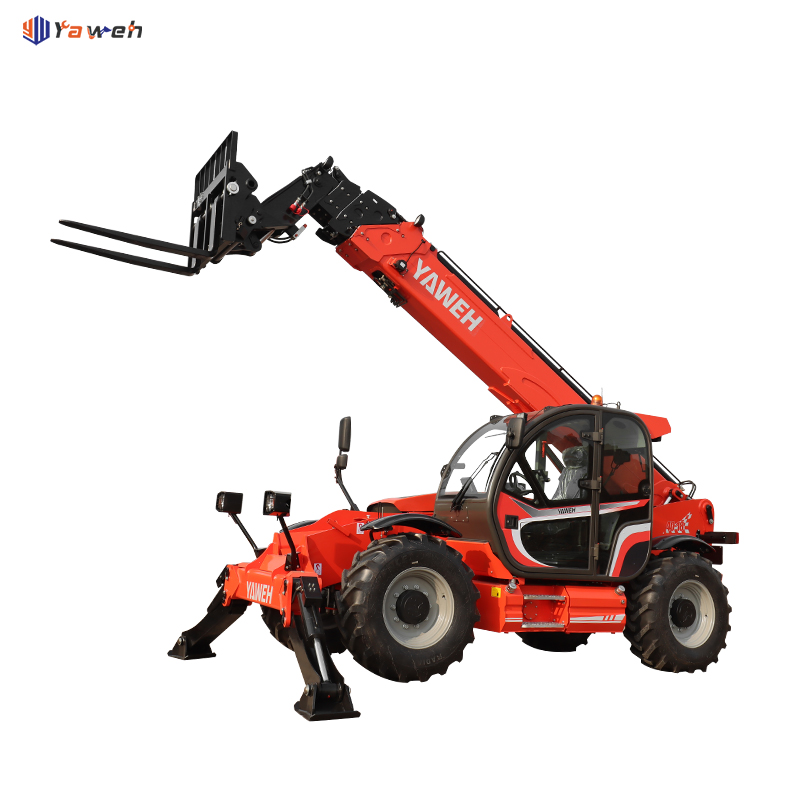
Selectable steering provides the baseline for maneuverability. However, the physical environment dictates how effectively that agility can be applied. Machines designed specifically for harsh environments integrate their steering systems seamlessly with ruggedized chassis components.
Dedicated off-road models are engineered with specific design features to conquer unpaved environments. Deep-tread pneumatic tires provide aggressive grip. High ground clearance avoids bottoming out on hidden rocks or demolition debris. Thick steel plating typically shields the steering cylinders and heavy-duty tie rods to prevent catastrophic damage from environmental hazards.
Weather conditions drastically alter site accessibility overnight. Standard two-wheel drive equipment quickly loses traction in deep mud or heavy winter snow. A rough terrain unit utilizes full-time four-wheel drive in conjunction with its steering modes to maintain relentless forward momentum. If the machine begins to sink into slick ruts, operators utilize crab steering to climb the tires out of the trench walls. Directing the wheels diagonally finds fresh, uncompacted traction on the edges of the track rather than spinning helplessly in the soupy center.
Recent market analyses surrounding material handling equipment highlight a massive shift toward electro-hydraulic automation. Job sites are becoming increasingly congested. Project timelines are shrinking. Consequently, the demand for smarter, more intuitive steering systems is surging across the heavy equipment sector.
Historically, switching steering modes required purely mechanical or basic hydraulic inputs. This left ample room for operator error. Switching modes while moving causes severe mechanical sheer. Today, the industry is trending rapidly toward steer-by-wire technology. Modern machines are increasingly equipped with intelligent onboard computers. These systems actively monitor wheel alignment, ground speed, and boom extension. If an operator attempts to engage a new steering mode while traveling at unsafe speeds, the system automatically locks out the request until the machine comes to a safe halt.
Sensor-assisted wheel alignment is becoming a standard expectation rather than a luxury add-on. Proximity sensors on the axles provide real-time haptic or visual feedback to the cabin. This ensures tires are perfectly synchronized before a mode transition occurs. Integrating Load Moment Indicators with steering lockouts is another major advancement. This prevents operators from executing sharp four-wheel turns when the boom is fully extended under heavy load. This technological evolution extends the lifespan of hydraulic cylinders and drastically reduces tip-over risks.
Selecting the correct machine requires a meticulous analysis of the site constraints matched against specific material handling requirements. Oversizing the equipment leads to unnecessary rental costs and frustrating logistical nightmares. Undersizing creates severe, immediate safety hazards.
For a vast majority of residential contractors and masonry professionals, a 3.5 Ton Telehandler represents the optimal balance of lifting power and nimble agility. Models like the T935 feature a 9.5-meter reach alongside a highly compact chassis. A 3.5-ton capacity easily hoists standard construction materials like full pallets of cinder blocks or heavy bundled lumber. The compact footprint allows the machine to fully utilize coordinated and diagonal steering within highly confined spaces. A larger machine might simply be too wide to fit between property lines, rendering its advanced steering useless.
Heavy commercial construction and massive steel erection projects demand heavy-duty models with capacities of 5 tons, 10 tons, or higher. These behemoths feature elongated wheelbases and massive booms. The fundamental role of steering shifts in these extreme applications. Maneuverability remains a factor, but absolute stability under crushing loads takes priority. Turning radii are naturally larger. Operators rely on steering modes less for squeezing through tight alleys and more for making slow, calculated adjustments when positioning multi-ton steel girders.
The advanced directional capabilities of a telehandler are incredibly beneficial. However, improper use or frantic switching between modes leads to catastrophic mechanical failure and severe workplace accidents. Strict adherence to safety protocols is non-negotiable from an engineering standpoint.
Never switch steering modes while the machine is in motion. The hydraulic systems that control heavy wheel articulation operate under immense pressure. Changing modes while driving forces the hydraulic valves to reroute fluid while actively fighting rolling resistance. This reckless action causes immediate seal blowouts, snapped tie rods, or a sudden lurch in direction. Always bring the equipment to a complete, controlled stop before touching the selector switch.
Verify that all four wheels are perfectly aligned in the straight-ahead position before transitioning. Unsynchronized axles cause dog-tracking. The rear wheels become offset from the front. The machine will travel at an awkward, unintended angle even when the steering wheel is held dead straight. Perform a quick visual check despite modern alignment sensors.
Operating this machinery requires a high degree of spatial awareness. Driving diagonally alters standard visual reference points and creates entirely new blind spots. Operators must receive comprehensive training on steering dynamics, load chart calculations, and site-specific hazard assessments before turning the ignition key.
Evaluating the steering system and its associated ergonomic features is a critical part of the procurement process. Efficiency on the job site relies heavily on intuitive, accessible controls.
Evaluate the cabin ergonomics carefully. Look for equipment that features a simple, clearly labeled dashboard toggle or seamless integration directly into the primary multi-function joystick. Complicated selector valves discourage operators from utilizing the safest steering mode for the task at hand.
Visibility is another paramount concern. Advanced steering modes require moving the machine in non-traditional directions. A high-quality unit must offer exceptional, unobstructed 360-degree visibility. Low-profile booms and expansive glass enclosures allow the operator to clearly see all four tires. This is absolutely crucial when sliding diagonally near open trenches or ground personnel.
Verify the machine's compatibility with a wide array of attachments. Utilizing four-wheel steer to navigate a tight yard becomes exponentially more valuable when the machine quickly switches between standard forks, heavy material buckets, and truss booms via a robust hydraulic quick-coupler.
Mastering telehandler steering modes unlocks the full potential of these incredible machines. Understanding how different hydraulic configurations interact with the physical environment drastically increases site safety and saves valuable operational time. Front-wheel steer provides the stability needed to travel swiftly across open job sites. Four-wheel steer easily conquers the tight corners of congested lumber yards. Crab steering allows for flawless diagonal positioning of heavy loads in the most confined spaces imaginable. Evaluate your specific job site conditions carefully. Whether you require a highly versatile 3.5-ton model for residential work or a heavy-duty unit for commercial steel erection, selecting the proper steering configuration streamlines your entire material handling workflow.
Ready to upgrade your fleet's maneuverability and tackle the toughest job sites? Explore the full range of high-performance material handling equipment at Yaweh Backhoe to find the exact model and steering configuration that fits your project needs.
No. For safety and mechanical integrity, you must bring the machine to a complete, controlled stop before changing modes. Switching while in motion causes unpredictable directional lurches, potentially destabilizing a raised load and causing a tip-over. It also places severe dynamic stress on the hydraulic cylinders and tie rods, leading to premature mechanical failures. Always stop and ensure the wheels are aligned straight before switching configurations.
Crab steering allows all four wheels of the machinery to turn in the exact same direction, enabling the entire chassis to glide diagonally. Operators primarily utilize this function for sliding the equipment sideways away from recently built walls, deep utility trenches, or delicate scaffolding. It precisely positions heavy loads in confined areas without the need to reverse and realign the entire footprint.
Yes, a 3.5-ton capacity machine is highly effective on modern construction sites. It provides an optimal balance of lifting muscle for hoisting standard pallets of bricks, wet lumber, and roofing materials while maintaining a compact physical footprint. This smaller size fully exploits coordinated and diagonal steering modes in tight commercial aisles where heavier models cannot operate safely.
While most are engineered with general off-road applications in mind, a dedicated rough terrain model features highly specialized components. These include aggressive deep-tread tires, enhanced four-wheel-drive hydrostatic transmissions, heavy-duty planetary axles, and significantly higher ground clearance. These engineering choices maintain relentless traction through deep mud and loose gravel.
By pivoting the front wheels in the desired direction and the rear wheels in the exact opposite direction, the machine rotates around a much tighter central axis. This dual-axle articulation allows a bulky piece of equipment to navigate sharp corners and narrow warehouse aisles with the agility of a much smaller machine.
If the axles are not synchronized straight ahead before switching, the machine experiences dog-tracking. The rear wheels become offset from the front. The equipment will travel at an unintended diagonal angle even when the steering wheel is pointed straight, compromising steering predictability and site safety.


