
English


Views: 0 Author: Site Editor Publish Time: 2026-11-26 Origin: Site


Picture this familiar scenario on a bustling job site. You are attempting to load a towering agricultural truck or stack bulk materials into an oversized processing hopper. Suddenly, you realize your standard equipment simply cannot reach the rim. This operational bottleneck is exactly where a Telescopic Loader proves its immense worth. Acting as the ultimate hybrid solution, this machinery combines the aggressive digging and heavy-duty loading capacity of a traditional articulated wheel loader with the extended vertical reach typically reserved for telehandlers.
Depending on the specific size, chassis, and model, these versatile machines can comfortably dump materials anywhere from 12 feet to well over 20 feet in the air. In this comprehensive guide, we will break down operational dump heights by machine size. We will also clarify the critical mechanical differences between lift height and dump clearance, helping you select the exact equipment necessary to keep your site running efficiently.
Average Range Capabilities: Industry data indicates that most standard models offer operational dump heights between 12 and 16 feet. Meanwhile, specialized high-reach units designed for extreme industrial applications easily exceed 20 feet in clearance.
Lift vs. Dump Height Distinction: Maximum lift height is fundamentally higher than the actual dump clearance. Equipment buyers must calculate their requirements based strictly on dump clearance to ensure transport trucks and hoppers are safely cleared without collisions.
Machine Class Variations: Compact units are engineered for tight spatial constraints with moderate height requirements. In contrast, heavy-duty models are structurally reinforced for high-clearance, industrial material handling tasks.
Safety is Paramount: Operating any heavy machinery at its maximum extension shifts the equipment's center of gravity drastically. This requires strict adherence to manufacturer load charts and mandates level-ground operation to prevent catastrophic tipping incidents.
Why are we seeing a sudden, massive surge in demand for extended-reach machinery? The answer lies in commercial real estate costs and operational scaling. Across the waste management, recycling, and agricultural sectors, land is becoming increasingly expensive. To maximize footprint efficiency, facilities are building upward rather than outward.
High-capacity processing hoppers are getting taller. Walking-floor trailers are maximizing their vertical volume to reduce transportation trips. Standard wheel loaders simply cannot keep up with these newly elevated thresholds. Consequently, upgrading to extended-reach machinery is no longer just a luxury for large corporations. It has become a strict operational necessity for businesses of all sizes to maintain site efficiency and stay competitive.
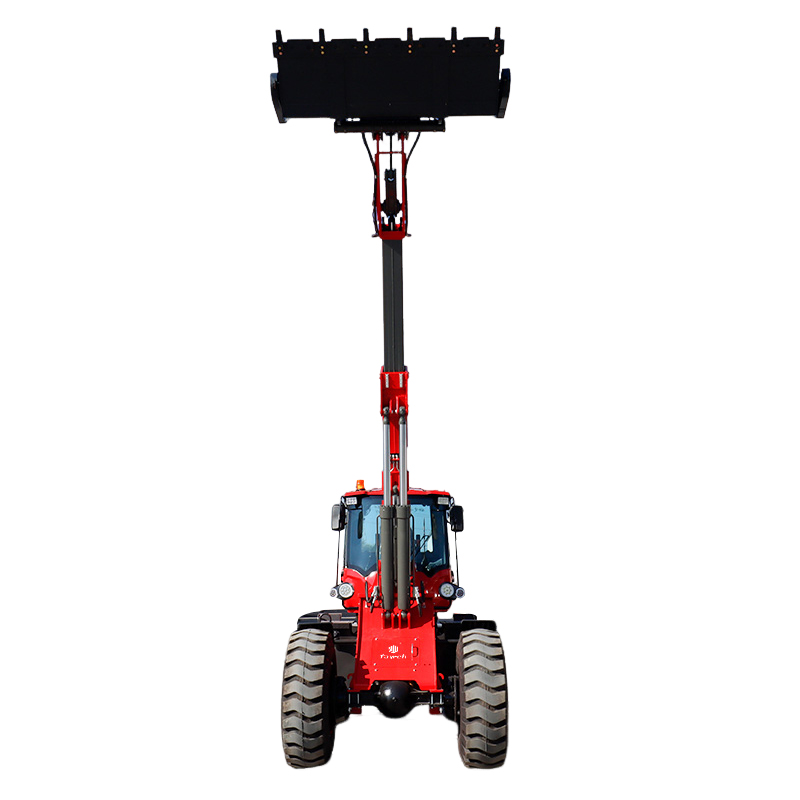
To make an informed equipment purchasing decision, you must understand exactly what this machinery is from a mechanical standpoint. Often referred to as a tele-wheel loader, this equipment represents a specialized engineering solution. It utilizes the articulating chassis, robust drivetrain, and aggressive breakout force of a traditional wheel loader. However, it replaces the standard rigid loader arms with an extendable hydraulic boom.
This unique design grants the operator the pushing power to navigate a muddy yard full of wet gravel. Furthermore, it provides the vertical and forward reach capabilities needed to deposit that material over high walls.
Dump height is arguably the most critical performance metric for buyers evaluating these machines. In material handling, if a machine cannot physically clear the side of a receiving vessel, it becomes operationally useless for that specific task. Whether the objective is loading a high-sided trailer at a bustling waste transfer station or dumping silage into a high-capacity feed mixer, the dump clearance dictates the machine's ultimate utility.
From an engineering perspective, the telescopic boom provides these hybrid machines with a 30 to 50 percent height advantage over standard wheel loaders within the exact same weight and horsepower class. This extended reach completely eliminates the need for constructing artificial dirt loading ramps. It also drastically reduces the risk of material spillage, ultimately improving both site efficiency and worker safety.
Understanding the correlation between machine size, engine horsepower, and vertical reach is vital for matching equipment to your specific operational demands. These loaders are generally categorized into three distinct size classes. Let us look at the real-world specifications.
The compact class typically encompasses agile machines operating under 50 to 75 horsepower. These units are specifically engineered for maneuverability, featuring a smaller physical footprint and exceptionally tight turning radiuses.
On average, a compact telescopic loader like the T2500 series handles a rated payload of around 2,500 kg. It provides a functional dump height ranging from 10 to 14 feet. Because of their dimensional advantages, these machines are highly favored in sectors where space is at an absolute premium. Ideal use cases include small agricultural farms, commercial landscaping yards, and navigating the confined interiors of older barns. Despite their smaller stature, the extendable boom allows them to perform loading tasks that would otherwise require a much larger, clumsier machine.
Stepping up in raw power and structural mass, the mid-size class generally ranges between 75 and 120 horsepower. These machines strike an excellent balance between yard maneuverability and heavy-duty lifting capacity.
For instance, a long reach telescopic loader such as the T3000 model manages a robust 3,000 kg payload. The average dump height for these mid-size units falls between 14 to 17 feet. This vertical reach is more than sufficient for the vast majority of standard commercial applications. They serve as the reliable backbone of municipal waste transfer stations and general construction material handling. They possess the hydraulic power to handle denser materials like compacted soil while still providing enough reach to load standard commercial dump trucks efficiently.
For the most demanding industrial environments, the heavy-duty or high-lift class is required. These massive machines boast engines exceeding 120 horsepower. They feature heavily reinforced chassis designed to counterbalance massive payloads at extreme elevations.
A high lift telescopic loader like the T3500 series handles payloads up to 3,500 kg and can deliver impressive dump heights ranging from 18 to well over 22 feet. These exceptional metrics are non-negotiable for specific heavy industries. Primary use cases include large-scale biomass energy facilities, heavy industrial recycling centers, and operations requiring the loading of high-sided rail cars where standard equipment falls dangerously short.
| Machine Class | Example Model | Rated Payload | Average Dump Height | Primary Application |
|---|---|---|---|---|
| Compact | T2500 | 2,500 kg | 10 - 14 ft | Confined agricultural barns, urban landscaping |
| Mid-Size | T3000 | 3,000 kg | 14 - 17 ft | Waste transfer stations, standard commercial trucks |
| High Lift | T3500 | 3,500 kg | 18 - 22+ ft | Biomass plants, high-sided rail cars, heavy recycling |
One of the most common and costly errors made during the procurement of heavy machinery is confusing lift height with dump height. Machinery brochures frequently highlight the maximum lift height in bold print because it presents a larger, more impressive number. However, relying on this metric for day-to-day applications can be highly misleading.
Maximum Lift Height: Also known as hinge pin height, this measurement is the vertical distance from the ground to the bucket's hinge pin when the boom is fully raised and extended. While it accurately indicates how high the boom arms can reach, it completely fails to account for the physical dimensions of the bucket itself.
Dump Clearance: This is the functional, real-world measurement operators must rely on. It is defined as the vertical distance from the ground to the lowest hanging edge of the bucket when the boom is fully raised, fully extended, and the bucket is tipped downward at a 45-degree angle. This is the standard angle required to successfully empty material into a vessel.
Because the bucket pivots downward from the hinge pin to release its payload, the actual dump height is invariably lower than the lift height. Depending on the bucket's depth and design, the dump clearance is usually 2 to 4 feet lower than the maximum lift height. Buyers must rigorously verify the specific dump clearance specification before signing a purchase order.
The maximum vertical clearance of a specific machine is not solely determined by its overall size category. Rather, it is dictated by a complex combination of mechanical engineering choices and physical configurations.
The primary driver of vertical reach is the fundamental architecture of the boom itself. Telescopic booms utilize internal hydraulic cylinders to push outward and upward. Single-stage booms feature one extending section, offering a highly reliable, moderate increase in reach. Multi-stage booms allow for significantly higher reach capabilities. Ultimately, the stroke length of the internal hydraulic cylinder directly dictates the absolute maximum extension.
In addition, the geometric design of the bucket and its pivot points drastically alter the final dump clearance. A larger, deeper bucket explicitly designed for lightweight materials will hang much lower when tipped at a 45-degree angle. This reduces the effective dump height. Conversely, operators can artificially increase their clearance by utilizing specialized attachments like high-tip buckets. These feature secondary hydraulic cylinders that push the bucket forward and upward from a separate frame, adding 1 to 2 feet of clearance.
Finally, the physical stance of the machine plays a definitive role. Upgrading a loader to larger, high-profile industrial tires can elevate the machine's axles and chassis. This simple modification adds several crucial inches to the final dump height, which is often the deciding factor when attempting to clear the rigid edge of a standardized hopper.
Selecting the appropriate machinery for high-reach applications requires a methodical, data-driven approach. Overestimating your needs leads to unnecessary capital expenditure. Underestimating leads to frustrating operational bottlenecks. Follow these engineering-focused steps to ensure you make the right choice.
Measure Your Target Accurately: The foundational step begins directly at the job site. Accurately measure the exact distance from the ground to the highest top edge of the tallest truck, feed hopper, or recycling bin you will routinely load. Do not rely on estimates. Record these measurements meticulously.
Add a Necessary Operational Buffer: Ground conditions on active job sites are rarely perfectly flat. Mud, deep ruts, and uneven terrain easily alter the machine's angle. Furthermore, materials often pile up in the center of a truck bed before settling. To account for these unpredictable variables, add a strict safety buffer of at least 1 to 2 feet to your target measurement.
Evaluate Payload vs. Height Trade-offs: There is an inherent physical trade-off in telescopic machinery. As the boom extends to its maximum height and forward reach, the safe lifting capacity drastically decreases due to leverage. Verify that the machine can safely lift the specific weight of your densest material at the absolute height you require. Lifting dry wood chips requires vastly different machine capabilities than lifting wet, dense gravel.
Consult Manufacturer Load Charts: Never rely on general assumptions. Before finalizing any purchase, thoroughly review the manufacturer's official load charts. Comparing the specific load curves of different models ensures the chosen machine will perform safely under the exact parameters of your intended job site.
While the extended reach of these machines provides immense utility, it also introduces complex physical dynamics. Operators must respect these dynamics to maintain site safety. Human error or environmental factors can easily compromise stability when a machine is pushed to its limits.
The fundamental physics of a loader change drastically as the boom extends. When a heavy payload is lifted and pushed outward, the machine's center of gravity migrates forward and upward. This shift significantly reduces the weight pressing down on the rear axle. If the weight of the load combined with the leverage of the extended boom exceeds the counterweight of the machine's rear end, a forward tip-over is mathematically inevitable.
Because the center of gravity is elevated, lateral stability is severely compromised at maximum height. It is a strict requirement to operate on flat, highly stable ground when dumping at high elevations. A slight dip or a hidden pothole under one single tire can cause a catastrophic lateral rollover when the boom is fully extended into the air.
To actively mitigate these risks, modern machines are equipped with advanced safety technology. Load Moment Indicators use sophisticated sensors to calculate the weight of the load against the boom's angle and extension. If the operator attempts to push the machine beyond its safe operational limits, the system triggers visual and audible alarms in the cabin. In many advanced systems, it will physically lock out further boom extension to prevent an accident.
A telescopic loader is a highly valuable, transformative asset for operations that require both heavy pushing power and exceptional vertical reach. Offering versatile dump heights that range from 12 to over 22 feet, these machines bridge the gap between standard earthmovers and dedicated lifting equipment.
When selecting your next machine, always remember to focus on the functional dump clearance rather than just the impressive lift height. Carefully balance your specific vertical height requirements with your daily payload needs, ensuring you never sacrifice safety for reach. By thoroughly evaluating your job site targets and consulting official load charts, you can confidently find the perfect equipment match to streamline your daily operational tasks and boost overall productivity. Ready to upgrade your fleet? Explore the full range of high-performance equipment at YAWEH to find the exact model that fits your height and payload requirements.
Yes, it is mechanically possible to increase the effective dump height of an existing machine. The most common method is installing a high-tip bucket, also known as a roll-out bucket. Unlike standard buckets that pivot on a single hinge pin attached directly to the boom, a high-tip bucket features a secondary frame with its own set of hydraulic cylinders. When activated, these cylinders push the bucket forward and upward, effectively increasing the clearance by an additional 1 to 2 feet. Another method involves upgrading to larger, high-profile industrial tires to elevate the entire chassis. However, any modifications must be approached with caution, as they affect the machine's center of gravity and payload capacity.
The answer depends entirely on the primary function and environment of your operation. A standard telehandler features a rigid chassis with four-wheel steering and generally offers superior maximum vertical reach. This makes it ideal for lifting palletized materials to high scaffolding on static construction sites. Conversely, a telescopic loader utilizes an articulated chassis, combining the aggressive digging, bucket breakout force, and pushing power of a traditional wheel loader with extendable reach. For high dumping applications involving loose, bulk materials, the articulated loader is generally superior due to its faster cycle times and better maneuverability in tight loading yards.
Yes, absolutely. This is a fundamental law of physics that applies to every piece of extendable machinery in existence. The relationship between boom extension and lifting capacity is inversely proportional and is strictly governed by the machine's load chart. When the boom is fully retracted, the load is positioned close to the machine's front axle, allowing the rear counterweight to provide maximum leverage. As the boom extends outward, the load moves further away from the pivot point, increasing the leverage the load has against the machine. To prevent the equipment from tipping forward, the safe operating capacity must decrease accordingly.
The primary difference lies in the design of the lifting mechanism and the resulting operational versatility. A standard wheel loader utilizes fixed-length, rigid loader arms. This solid design is engineered for maximum breakout force, allowing the machine to aggressively dig into heavily compacted earth. However, its vertical reach is strictly limited by the physical length of those arms. A compact telescopic model replaces those fixed arms with a single, extendable hydraulic boom. While it may sacrifice a marginal amount of raw digging force, it gains a massive advantage in reach and dump clearance, allowing it to reach over obstacles and load high-sided trucks with ease.
To get an accurate measurement, park the transport truck or hopper on the exact terrain where loading will occur. Use a laser measure or a rigid measuring tape to find the distance from the ground to the absolute highest point of the vessel's side wall. Do not measure to the inside floor of the truck. Once you have this exact vertical number, add a minimum of 18 to 24 inches to account for suspension squat, uneven mud, and the material crowning in the center of the truck bed. This final number is your required dump clearance.
Yes, they are exceptionally well-suited for loading walking-floor trailers, which are notoriously high-sided and difficult to clear with standard equipment. Because walking-floor trailers are often used in waste management and biomass sectors to haul low-density, high-volume materials, operators need significant forward reach to distribute the load evenly across the trailer bed. A mid-size or high-lift model provides both the vertical clearance to clear the trailer walls and the forward extension necessary to dump material directly into the center of the trailer, preventing uneven loading and spillage.


