
English


Views: 0 Author: Site Editor Publish Time: 2026-08-15 Origin: Site


Operating a quarry pushes heavy machinery to its absolute limits every single day. Abrasive silica dust, severely uneven grades, and massive payloads like multi-ton granite blocks demand uncompromising equipment durability. Procurement teams often face a difficult conflict when upgrading their fleets. They must balance the upfront capital efficiency of standard warehouse equipment against the strict operational necessity of specialized rough terrain machinery. Choosing the wrong asset quickly leads to stalled production and severe safety hazards.
This article breaks down those critical differences for operations managers. We will explore how surface realities and extreme payloads dictate your equipment choices. You will receive a direct, evidence-based evaluation framework. We structured this guide to help you select the exact material handling asset your operation needs. By understanding the distinct engineering behind these machines, you can prevent costly misapplications and keep quarry workflows running smoothly.
Standard forklifts fail in quarry environments due to insufficient ground clearance, polyurethane/cushion tires, and 2WD limitations, leading to frequent bog-downs and chassis damage.
Off-road models offer 4WD, pneumatic deep-tread tires, and wider stances, making them mandatory for unpaved, graded mining solutions.
For extreme payloads (e.g., moving 30+ ton stone blocks), a specialized 35T off road forklift is required over standard high-capacity warehouse models.
Total Cost of Ownership (TCO) in a quarry heavily favors off-road models when factoring in reduced retrieval downtime and lower transmission wear.
Selecting the right equipment starts with a brutal assessment of your working environment. Quarries represent one of the most hostile industrial settings for heavy machinery. You cannot simply deploy indoor equipment outside and expect reliable performance.
Quarry extraction involves moving raw, asymmetrical stone blocks. These loads behave entirely differently than standard palletized goods. An asymmetrical block possesses a shifting center of gravity. When a machine lifts raw granite or marble, it experiences constant, unpredictable vibration. This dynamic shifting forces the mast and chassis to absorb immense lateral stress. Proper heavy duty material handling requires equipment engineered to counter these dynamic loads safely without tipping.
You must contrast the smooth, paved surfaces of warehouse yards with actual extraction sites. Quarries feature rutted mud, loose gravel, and steep inclines. Rain instantly transforms compact dirt into hazardous slurry. Standard equipment relies on flat, predictable traction to move efficiently. In a quarry, wheels sink. Incline grades constantly shift. A machine needs specialized axle articulation to keep all four tires planted firmly on uneven, rocky surfaces.
Deploying standard warehouse equipment in a raw extraction zone guarantees failure. Operations managers frequently underestimate the severe financial and operational risks. These risks compound quickly:
Transmission Burnouts: Standard two-wheel-drive systems overheat rapidly when attempting to push through deep mud or gravel.
Blown Tires: Sharp rocks easily shred standard cushion tires designed for concrete.
Tipped Loads: A narrow chassis combined with uneven ground dramatically increases the likelihood of a rollover.
Production Bottlenecks: When a machine gets stuck, you lose hours of extraction time waiting for retrieval equipment.
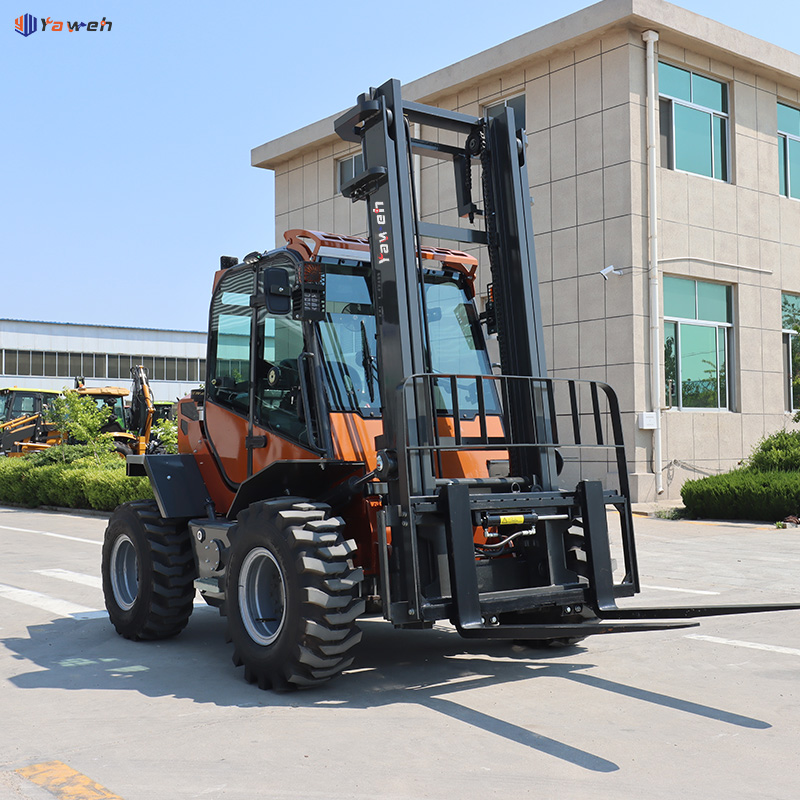
Understanding the engineering gap between standard units and specialized equipment prevents poor procurement decisions. The physical architecture of these machines dictates their survival in a quarry.
A standard forklift features a low center of gravity. Manufacturers build them this way to maximize vertical stability on flat concrete. However, this design offers minimal ground clearance. Conversely, an off road forklift uses an articulated or highly rigid frame with massive ground clearance. This elevated design allows the undercarriage to navigate large debris, deep ruts, and exposed rocks without suffering catastrophic undercarriage strikes.
Quarry traction demands absolute control. Standard warehouse models rely on basic two-wheel drive (2WD). They lack the mechanical ability to distribute torque evenly when wheels slip. Off-road units integrate heavy-duty four-wheel drive (4WD). They utilize locking differentials to force wheels to spin in unison. When one tire loses grip on a wet rock, the locking differential transfers power to the tires that still have traction. This engineering keeps the machine moving forward through severe terrain.
Tire selection determines whether a machine sinks or floats on loose terrain.
Standard Tires: Solid or cushion tires offer excellent wear resistance on concrete but provide zero shock absorption. They sink instantly in mud.
Off-Road Tires: Large, low-pressure pneumatic tires feature deep, aggressive treads. They absorb heavy shocks from rocky ground. The wider footprint distributes machine weight, preventing sinkage in loose gravel.
Once you understand the terrain, you must evaluate how specific machine architectures handle extreme weights. Quarry extraction requires highly intentional load planning.
Evaluating lift charts on uneven ground differs drastically from warehouse lifting. Lift capacities drop significantly when a machine operates on an incline. You must account for mast deflection. For primary block extraction, a 35T off road forklift provides the massive rear counterweight necessary to stabilize 30-ton blocks safely. Smaller off-road units work well for moving palletized aggregate, but they lack the structural rigidity required for primary raw stone extraction.
Many operators assume maximum lift capacity remains constant regardless of terrain. Never lift maximum payload limits on a slope. Always derate your capacity charts based on the specific grade of your quarry floor.
Choosing between a traditional vertical mast and a telescopic boom requires analyzing your primary workflow.
Vertical Mast Forklifts: These excel at heavy, stable vertical lifts. They offer superior stability when moving extremely dense loads straight up and down.
Telehandlers: A rough terrain telehandler offers forward reach. You choose this machine when you need to load flatbed trucks from one side or place materials over open trenches. They trade some vertical lift capacity for horizontal versatility.
Silica dust aggressively destroys internal combustion engines and hydraulic seals. Standard machines lack environmental shielding. Reliable mining solutions demand extreme component protection. You must look for machines featuring completely sealed wet disc brakes. They require cyclonic air filters to spin heavy dust particles out of the intake before reaching the main filter. Heavy-duty cooling systems with reversing fans blow accumulated debris out of the radiators automatically.
| Specification | Standard Warehouse Model | Off-Road Rough Terrain Model |
|---|---|---|
| Ground Clearance | Low (4 to 6 inches) | High (12 to 18+ inches) |
| Drivetrain | 2WD (Open Differential) | 4WD (Locking Differentials) |
| Tire Type | Cushion or Solid Polyurethane | Deep-Tread Pneumatic |
| Dust Protection | Basic air filters | Cyclonic pre-cleaners, sealed brakes |
Safety regulations govern quarry operations strictly. You cannot casually assign a warehouse operator to drive heavy extraction equipment without proper certification and physical machine safeguards.
Regulatory agencies recognize the extreme hazards of open-pit environments. OSHA and MSHA enforce strict distinctions between standard industrial trucks and rough terrain equipment. You must maintain separate compliance records for outdoor extraction machinery. Routine inspections for rough terrain units require specific checks on hydraulic leveling systems and axle oscillation mechanisms that do not exist on standard indoor models.
Operating heavy machinery on uneven quarry grades presents a massive rollover risk. Standard overhead guards offer basic protection against falling small boxes. In a quarry, you face the risk of falling stone fragments and complete machine inversion. Mandatory Falling Object Protective Structures (FOPS) and Roll-Over Protective Structures (ROPS) are non-negotiable. These heavily reinforced cages ensure the operator survives a catastrophic tip-over or a block failure.
Driving specialized terrain equipment involves a steep learning curve. Operators must master specialized steering modes.
Crab Steering: Moves the machine diagonally to escape tight ruts.
4-Wheel Steer: Drastically reduces the turning radius for maneuvering around extraction pits.
You must invest in advanced training certification. An untrained operator using the wrong steering mode on a slope can easily destabilize a heavy load.
Require operators to perform a mandatory ground-condition walkaround after every heavy rainstorm. Slopes deemed safe yesterday may become severe slip hazards today. Adjust load sizes accordingly.
Building a logical procurement shortlist requires aligning machine capabilities directly with your facility footprint. You must separate your site into distinct working zones to make accurate purchasing decisions.
You should only consider standard equipment if your quarry features a fully paved, climate-protected secondary processing facility. If the machine exclusively moves finished, palletized stone across smooth concrete floors with zero exposure to raw terrain, standard models work perfectly. They offer excellent maneuverability in tight indoor aisles and require less initial capital.
You must shortlist rough terrain models for all extraction zones and unpaved staging areas. If your workflow involves moving raw blocks from the pit directly to transport trucks, standard machines will fail. Terrain-rated equipment represents a mandatory requirement for any application where tires touch mud, gravel, or graded earth.
Operations managers must weigh higher upfront capital expenditure against long-term operational efficiency. Specialized rough terrain units require larger initial investments. However, you eliminate the constant towing costs associated with retrieving stuck warehouse machines. You reduce transmission maintenance cycles because purpose-built axles handle the torque properly. Most importantly, you drastically increase the daily tonnage moved. A machine that never gets stuck and safely lifts massive loads directly accelerates your overall production output.
Selecting the appropriate heavy machinery for quarry handling comes down to acknowledging environmental realities. You cannot compromise on traction, ground clearance, or structural integrity when dealing with heavy stone extraction. Standard warehouse models excel on concrete but pose extreme safety and operational risks on raw earth.
To move forward successfully, take action on these immediate next steps:
Conduct a comprehensive site survey: Measure the maximum grades of your extraction routes.
Assess weather impact: Document typical ground conditions after heavy rainfall to determine your required tire tread depth.
Define maximum payloads: Calculate the exact weights of your largest raw blocks before requesting vendor specification sheets.
By executing these steps, you guarantee your procurement choice aligns perfectly with your operational demands, ensuring maximum uptime and superior workplace safety.
A: No. Retrofitting tires does not solve the lack of ground clearance, 4WD, or heavy-duty axle requirements. Standard frames will eventually crack under uneven quarry stress. You cannot safely upgrade a warehouse unit to handle harsh outdoor extraction tasks.
A: Capacities vary widely depending on the manufacturer. Specialized heavy-duty units (like a 35T off-road forklift) are specifically engineered for maximum quarry block weights. While some custom machines lift even more, 35 tons covers most extreme primary extraction needs safely.
A: It depends entirely on your specific task. Telehandlers offer unmatched reach and versatility for loading trucks or reaching over trenches. Meanwhile, heavy-duty mast forklifts generally provide much higher maximum lift capacities for dense, localized lifting tasks.
A: While built exceptionally tougher, the harsh quarry environment necessitates rigorous upkeep. You must perform more frequent air filter replacements, hydraulic fluid checks, and tire pressure monitoring compared to standard indoor units. Daily inspections remain critical to prevent catastrophic failures.


