
English


Views: 0 Author: Site Editor Publish Time: 2026-05-20 Origin: Site


Selecting heavy equipment represents a crucial decision for contractors. Picking the wrong machine leads to frustrating project delays. It inflates your transportation budget needlessly. You also risk wasting valuable rental capital. Both platforms handle excavation and material moving effectively. However, their distinct form factors dictate completely different capabilities. A wheeled machine features a 180-degree operational pivot. A tracked unit uses continuous 360-degree rotation. These mechanical contrasts change operational efficiencies dramatically. They alter your project timelines and expected returns.
This guide provides a realistic, evidence-based decision framework. We move past basic definitions to evaluate raw job site performance. You will learn how to assess site suitability properly. We also examine essential acquisition strategies. Our goal is simple. We want to help you deploy the perfect machinery for your specific daily applications.
Mobility vs. Power: Backhoe loaders offer superior multi-site mobility and versatility via roading capabilities, while excavators provide unmatched digging depth, breakout force, and 360-degree stability.
Footprint limitations: Excavators excel in confined spaces where the machine can remain stationary and pivot, whereas backhoes require more maneuvering room but cause less ground damage on finished surfaces.
TCO variables: A backhoe loader often serves as a "two-in-one" solution for varied, light-to-medium tasks, whereas an excavator maximizes ROI on dedicated, high-volume earthmoving projects.
Vendor evaluation: Support from your specific backhoe loader manufacturer or excavator dealer heavily impacts uptime and parts availability.
Analyze the chassis first. Wheeled units provide incredible mobility across hard surfaces. Tracked undercarriages dominate uneven terrain. Wheels allow you to drive across finished asphalt safely. They preserve delicate concrete surfaces during municipal repairs. Tracks offer superior grip in deep mud. They distribute heavy machine weight over a massive surface area. Tracked excavators exert significantly lower ground pressure per square inch. This makes them mandatory for unstable terrain. They prevent your expensive equipment from sinking.
Swing radius dictates your operating speed. Wheeled machines feature a rigid frame. The rear digging arm pivots only 180 degrees. Operators must position the chassis perfectly before digging. Excavators feature a continuous 360-degree rotation. The entire house swings freely on a central slewing ring. This mechanical advantage transforms truck loading cycles. The operator digs, spins, and dumps without moving the tracks. It drastically reduces cycle times.
Evaluate the frontend utility next. Dual-function machines offer immense versatility. You get a massive front-loader bucket. It tackles loose material quickly. Dedicated digging platforms lack this feature. Excavators utilize a specialized frontend boom. You might get an optional backfill blade on smaller models. However, they cannot transport heavy pallets or scoop loose gravel efficiently across a large site.
Digging depth separates these two categories sharply. Excavators scale infinitely higher in sheer power. Large tracked units reach incredible depths for deep sewer installations. Their hydraulic cylinders produce massive breakout force. They slice through compacted clay easily. They conquer solid rock during demolition. The heavy tracked undercarriage anchors them firmly. This allows maximum hydraulic power transfer into the earth without tipping.
Material handling presents a different narrative. You gain a huge advantage moving loose material using a front loader bucket. It sweeps across a messy site quickly. You haul gravel, sand, or debris effortlessly. You rarely need a secondary wheel loader. A backhoe loader handles all backfilling duties seamlessly. It scoops dirt and drops it over fresh trenches fast.
Hydraulic attachments expand your operational limits. Both platforms support robust ecosystems. You can equip hydraulic breakers for concrete removal. You can attach augers for fence post holes. Vibratory compactors secure loose soil safely. Hydraulic thumbs grab awkward demolition debris securely. They allow you to pinch rocks, logs, or torn concrete easily. Continuously rotating machines usually drive higher hydraulic fluid flows. This powers demanding attachments like heavy-duty breakers more efficiently.
Tip: When evaluating a backhoe loader excavator combination fleet, prioritize universal quick-couplers. They maximize attachment interchangeability across different brands. This reduces idle time dramatically. It keeps your crew working instead of wrestling with stubborn mounting pins.
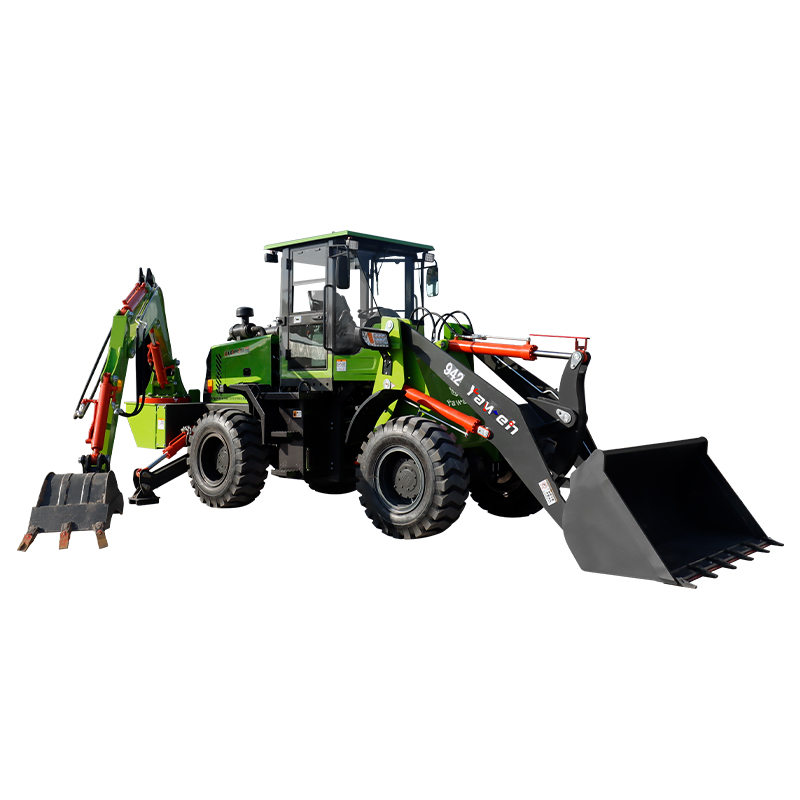
A modern backhoe loader equipped with versatile front and rear attachments simplifies job site material handling.
Urban utilities and road repair present unique logistical hurdles. Space feels tight. You cannot block multiple traffic lanes safely. Wheeled units often win these contracts. You drive them straight onto asphalt without causing damage. You transit between municipal sites quickly. You never wait for a lowboy trailer to arrive. They fix water main breaks and restore the road surface independently.
Agriculture and landscaping demand varied functionality. Farms require constant maintenance. You haul animal feed in the morning. You dig irrigation lines in the afternoon. Wheeled utility machines excel here. They cover large acreages quickly. Tight-access landscaping favors mini-excavators instead. Residential backyards feature narrow gates. Small tracked units squeeze through easily. They dig retaining wall foundations without destroying fragile turf.
Heavy construction and demolition require uncompromised strength. You face brutal tasks daily. Standard and large excavators are non-negotiable for these demanding environments.
Deep Foundations: They remove massive volumes of dirt quickly and safely.
Mass Excavation: Continuous rotation keeps dump trucks moving efficiently.
Heavy Lifting: The stable track base allows operators to lower massive concrete pipes securely into trenches.
Demolition: They reach high walls and crush structures using heavy hydraulic shears.
Let us examine acquisition and rental costs. Initial purchase prices vary based on operating weight. You must compare similarly weighted machines carefully. A 15,000-pound wheeled machine costs differently than a 15,000-pound tracked unit. Standard rental rates reflect these engineering differences. Tracked models often command premium daily rates due to rapid undercarriage wear.
Transportation logistics dictate hidden project expenses. Moving tracked equipment costs serious money. Excavators require specialized heavy-duty trailers. You must hire licensed CDL drivers to haul them. You burn fuel just transporting the iron. Wheeled machines bypass these hurdles completely. You drive them directly to the site. This eliminates expensive delivery fees.
Evaluating your supply chain guarantees long-term success. Choosing a reputable backhoe loader manufacturer matters deeply. Strong dealer networks provide reliable aftermarket support. You secure parts faster when things break. This minimizes expensive downtime. Quality manufacturing also ensures higher resale values.
Watch for emerging market trends. Shifts in the backhoe loader manufacturing industry impact everyday running costs. Engineers constantly improve hydraulic efficiencies. Better pumps save expensive diesel fuel. Hybrid options reduce daily emissions. These innovations lower your operational expenses over a machine's entire lifespan.
Tip: If your project spans multiple separate sites within a 15-mile radius, run the math. Calculate the exact time and cost saved by roading your wheeled equipment. You avoid repeatedly loading and unloading heavy tracked machinery.
Follow this structured approach to pick the right machine. Rely on hard data instead of operator preference.
Step 1: Define the primary task volume. Analyze your daily operations honestly. If you spend 80% of your day trenching, pick the continuously rotating machine. If you split tasks evenly between digging and loading, pick the wheeled alternative.
Step 2: Assess site constraints. Walk the job site carefully. Look at ground conditions. Tracked machines ruin finished concrete. Note spatial limitations. You need room to maneuver a wheeled chassis. Identify surface fragility before unloading equipment.
Step 3: Analyze transportation logistics. Review your internal fleet capabilities. Can you move tracked machinery easily? Do you own a heavy lowboy trailer? Do you employ CDL drivers? If not, wheeled units save enormous logistical headaches.
Review this side-by-side matrix to visualize your choice.
| Category | Wheeled Utility Loader | Tracked Excavator |
|---|---|---|
| Mobility | Winner (Road capable) | Loser (Requires trailer) |
| Digging Power | Loser (Limited depth) | Winner (Infinite scaling) |
| Material Handling | Winner (Front bucket) | Loser (Digging focused) |
| Setup Time | Winner (Drive and park) | Loser (Load and strap) |
| Surface Impact | Winner (Hard finished surfaces) | Winner (Muddy/Soft ground) |
Neither machine reigns objectively better overall. Superiority strictly depends on your exact application. Wheeled models act as the ultimate utility players. They tackle diverse, multi-location tasks brilliantly. They drive across town, dig a hole, and backfill it independently. Tracked machines remain the apex choice for focused extraction. They dominate high-volume, stationary digging environments effortlessly.
Always consult with a dedicated fleet manager. Speak to an experienced rental specialist to audit your specific site requirements. Do this before finalizing any procurement or rental agreement. Their local insight prevents costly missteps. You will deploy the perfect iron and maximize your project profitability.
A: They share similar functions but face strict physical limitations. Wheeled machines cannot match the extreme digging depths of tracked units. Their cycle times trail behind continuously rotating machines. The 180-degree pivot restricts operating speed in tight spaces. You should deploy them for lighter, varied utility work rather than mass earthmoving projects.
A: Tracked digging machines use standard ISO/SAE joystick controls. Operators sit facing one direction continuously. This makes them highly intuitive for beginners. Wheeled utility machines present a steeper learning curve. The operator must master driving controls, front loader joysticks, and rear digging levers. Switching seats requires extra physical coordination.
A: Base daily rental rates often appear similar. However, transportation fees change the math completely. Delivery charges for tracked machines add up quickly. You can often drive a wheeled machine straight to your local job site. This eliminates expensive drop-off and pickup fees, making it more cost-effective for short projects.
A: Heavy equipment lifespans depend entirely on strict maintenance routines. A well-maintained wheeled machine typically lasts between 7,000 and 10,000 operating hours. Tracked digging machines often exceed 10,000 hours easily. The steel undercarriage on tracked units requires expensive rebuilding eventually. Regular greasing and fluid changes maximize longevity for both platforms.


