
English


Views: 0 Author: Site Editor Publish Time: 2026-08-04 Origin: Site


Outdoor yard storage presents unique material handling challenges. Traditional indoor warehouse equipment simply cannot survive these harsh conditions. Operators constantly battle rutted gravel, deep mud, and tight, unpaved alleyways. Deploying the wrong equipment quickly leads to stalled operations. It creates severe maintenance headaches. It also introduces significant safety hazards to your crew on the ground. When machines get stuck or tip over, your entire supply chain stops. You must choose carefully between a maneuverable mini unit and a rugged off-road machine. This decision requires an objective assessment of your exact terrain. You should carefully evaluate daily load limits. You must also measure your available operational footprint. We will help you navigate these exact criteria. You will learn how to match machine capabilities to your specific yard environment. This ensures maximum productivity and keeps your operators completely safe.
Terrain Dictates the Machine: Paved or hard-packed yards with tight aisles favor the mini forklift, while unimproved surfaces (gravel, mud, snow) strictly require an off-road model.
Capacity vs. Footprint: Compact machines sacrifice lift capacity and stability on uneven ground for a tighter turning radius.
Alternative Options: Exploring the broader forklift product range, such as adding a telehandler, may solve complex vertical stacking needs that straight-mast forklifts cannot address.
Total Cost of Ownership (TCO): Off-road models incur higher upfront and maintenance costs, requiring rigorous ROI justification before procurement.
You must understand your exact ground conditions before buying equipment. Do not guess your operational thresholds. Concrete behaves very differently than compacted crushed stone. Unimproved dirt quickly turns into hazardous mud after heavy rain. You must conduct a surface reality check first. Identify all the transition zones in your yard. Measure the actual turning radius required between storage racks. Look closely at the spacing between bulk material stacks. Check the clearances around your shipping containers. Space constraints dictate your equipment size.
Next, you should document your distinct load profiles. Determine the absolute maximum weight of your typical loads. Measure their exact physical dimensions. Find the true center of gravity for your most common pallets. Dynamic loads behave unpredictably on uneven ground. You must also evaluate seasonal weather exposure. Summer dust requires specialized engine filtration. Winter snow completely alters surface stability. Ice reduces tire traction to zero. Rain washes away compacted gravel over time. Consider how these environmental shifts impact your daily operations.
Identify primary surface materials across all travel paths.
Measure the narrowest chokepoints between storage structures.
Calculate the maximum weight and dimensions of daily payloads.
Assess seasonal weather impacts on ground traction and visibility.
Compact machines deliver exceptional maneuverability in restricted yard footprints. They offer lower initial acquisition costs compared to massive rough-terrain units. Many facilities now prefer low-emission electric models. These machines excel in highly controlled environments. Paved outdoor storage yards represent the ideal scenario. Building material centers with solid concrete pads also benefit greatly. Facilities requiring frequent indoor-to-outdoor transitions often rely on these compact units. They navigate tight warehouse aisles and then roll smoothly onto paved exterior lots.
However, you face strict implementation risks with smaller equipment. You risk catastrophic loss of traction on loose gravel. Wet soil quickly traps machines with small tires. Limited ground clearance creates another massive hazard. Machines become highly susceptible to high-centering on yard debris. Uneven grading can easily scrape the undercarriage. You must carefully deploy a mini forklift to optimize high-density layouts. It functions perfectly provided your ground conditions remain consistently flat and solid.
| Yard Environment | Suitability | Primary Reason |
|---|---|---|
| Paved Concrete Pads | Excellent | Smooth surface allows maximum traction and stability. |
| Compacted Gravel | Moderate | Requires pneumatic tires; risk of rutting exists. |
| Loose Dirt or Mud | Poor | Low ground clearance leads to immediate high-centering. |
| Steep Inclines | Poor | Small footprint lacks the necessary stability buffer. |
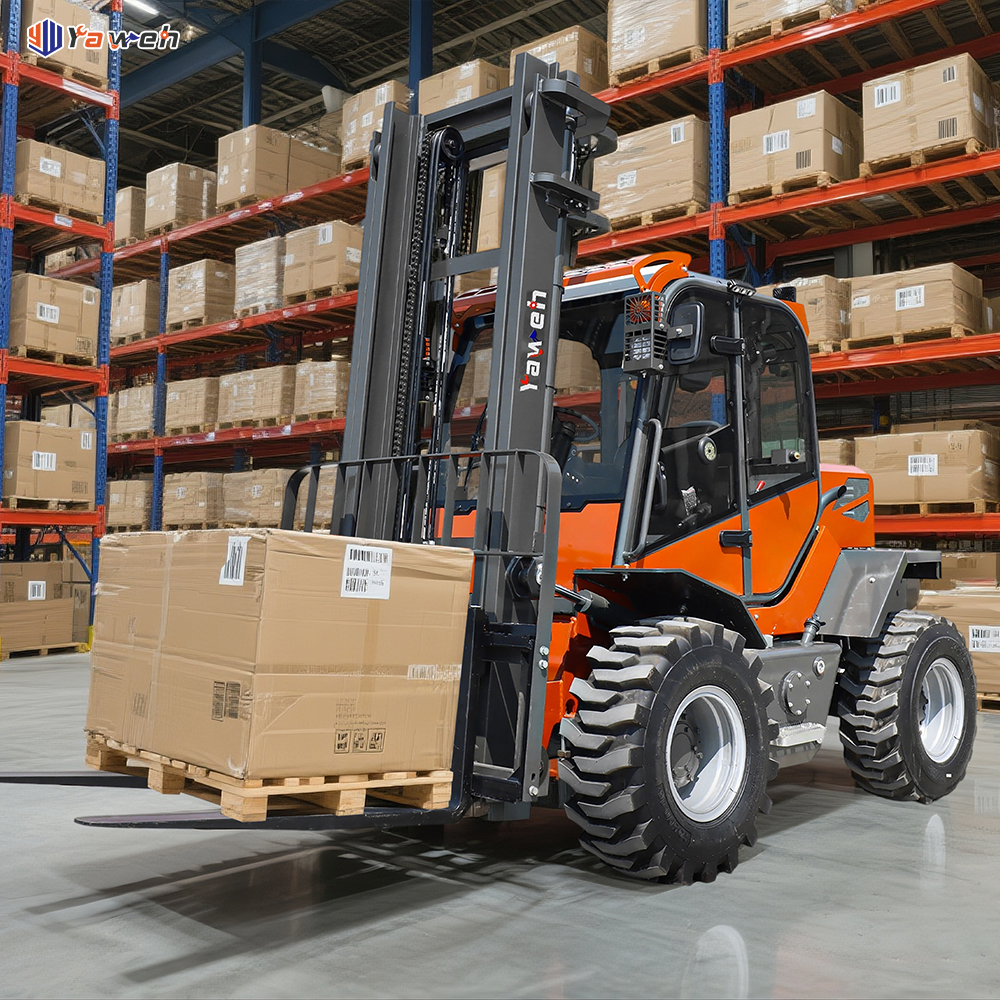
Rugged environments demand robust engineering. High ground clearance prevents the machine from getting stuck on debris. Heavy-duty pneumatic tires provide essential traction on loose surfaces. Operators often fill these tires with liquid for extra ballast. This lowers the center of gravity significantly. A robust straight-mast construction absorbs violent shocks from uneven ground. These core strengths make rough-terrain models indispensable. Construction laydown yards rely entirely on these powerful machines. Agricultural supply lots feature deep ruts and thick mud. Lumber yards often have unpaved slopes that require massive torque.
These machines do carry distinct implementation risks. Their larger physical footprint requires much wider operational aisles. You cannot navigate narrow warehouse racking with them. They consume significantly more fuel during daily operations. Their heavier machine weight can further degrade soft yard surfaces over time. You must balance power with spatial awareness. A compact off road forklift beautifully bridges this operational gap. It offers critical rough-terrain capability without the massive footprint of full-sized construction loaders.
You should understand the difference between vertical lift and forward reach. Standard straight-mast models only lift straight up and down. They face severe limitations when stacking materials in deep rows. A forward-reaching boom completely changes your handling capabilities. This allows operators to reach over existing inventory easily. They can access materials stored securely in the back rows. Yard applications expand significantly with this added reach. Operators can load and unload flatbed trailers from a single side. This eliminates the need to reposition the delivery truck.
However, you must consider the operational trade-offs carefully. Telescopic machines generally have a much wider turning radius. Their initial acquisition cost runs higher than standard straight-mast units. They also require highly specialized operator training. Load chart comprehension becomes critical when extending a heavy boom outward. We strongly advise buyers to evaluate their entire forklift product range carefully. You must determine if a telehandler aligns better with your specific yard handling solutions.
| Feature | Straight-Mast Model | Telescopic Boom Model |
|---|---|---|
| Reach Capability | Strictly vertical lifting only | Vertical lifting plus forward extension |
| Turning Radius | Relatively tight; good for aisles | Wide; requires open yard space |
| Loading Flatbeds | Requires access to both sides | Can load entirely from one side |
| Operator Training | Standard industrial truck certification | Advanced variable reach certification |
Equipment acquisition involves balancing immediate budgets with regulatory requirements. You must contrast the daily fuel expenses between standard and rough-terrain units. You must also evaluate changing compliance landscapes regarding emissions. Internal Combustion (IC) engines provide excellent heavy outdoor torque. They power through deep mud without hesitation. However, environmental regulations constantly tighten around diesel emissions. Many yards now transition to heavy-duty outdoor electric lithium-ion models. These modern electric units comply with strict local emission regulations. They also reduce daily noise pollution significantly. You must install proper high-voltage charging infrastructure to support them.
Safety and operator training remain paramount. OSHA strictly regulates powered industrial truck operations. Operating any machine on uneven terrain requires distinct certifications. Drivers must thoroughly understand complex load charts. Dynamic shifts in weight easily cause rollovers on slopes. You must implement rigorous risk management protocols. Mandate daily pre-shift inspections for tire pressure and mast integrity. Never allow untrained personnel to operate a standard forklift on wet or sloping ground. Strict compliance prevents tragic yard accidents.
Selecting the right machine requires a systematic approach. You should never purchase equipment based solely on a specification sheet. You must validate machine performance in your actual environment. Follow these exact steps to ensure operational success.
Conduct a Site Audit: Map out the absolute worst-case terrain conditions in your yard. Identify the tightest bottlenecks and narrowest aisles in your current setup. Measure these spaces physically.
Match Tires to Terrain: Ensure your final shortlist strictly filters out smooth cushion tires. You must specify pneumatic or foam-filled rough-terrain treads for unpaved surfaces. Traction represents your first line of defense.
Demo with Maximum Loads: Never evaluate a machine while it is completely empty. Test the unit under maximum payload in your specific yard conditions. This verifies actual mast stability and engine power.
Evaluate Support: Assess dealer proximity before signing a contract. Check their local parts availability. Verify their emergency service response times for the specific brands you selected.
Following this structured process removes emotion from the purchase. It guarantees your equipment matches your operational reality perfectly.
The choice between a compact unit and an off-road machine is rarely subjective. It is strictly dictated by the unforgiving realities of your yard's terrain and available space. A thorough site audit reveals exactly what your environment demands. You must measure turning radiuses, analyze ground stability, and weigh your heaviest loads. Do not compromise on terrain capability merely to save money or space initially. The resulting operational downtime and severe safety risks will quickly outpace any initial savings.
We recommend taking immediate action to secure your yard operations. Schedule a comprehensive site evaluation with an experienced equipment specialist today. Walk them through your worst-case weather scenarios and tightest chokepoints. Request a spec-by-spec comparison tailored specifically to your unique yard layout. Making an informed decision today ensures maximum productivity and keeps your operators safe tomorrow.
A: Generally no, unless the gravel is tightly compacted and the forklift is equipped with pneumatic tires. Even then, the risk of sinking or losing traction remains extremely high. Standard models lack the necessary ground clearance to navigate loose stones safely. You should upgrade to rough-terrain models for loose gravel surfaces.
A: An off-road forklift uses a straight mast for vertical lifting on rough terrain. A telehandler uses a hydraulic boom arm for both vertical and forward reach. Telehandlers allow operators to reach over obstacles and load flatbeds from a single side, but they require much wider turning spaces.
A: Yes, manufacturers are rapidly expanding their electric lines. They now include high-voltage, lithium-ion off-road models that offer comparable torque to traditional diesel engines. These units eliminate local emissions and reduce noise. However, they require you to install dedicated, high-capacity charging infrastructure on-site.
A: Take your heaviest typical load and factor in the load center distance accurately. For rough terrain, it is highly recommended to build in a 20-30% buffer capacity. This buffer accounts for dynamic shifts in weight when driving over uneven ground, ensuring maximum machine stability.


