
English


Views: 0 Author: Site Editor Publish Time: 2026-07-01 Origin: Site


Purchasing or renting heavy equipment represents a significant capital expenditure. Selecting the wrong machine for your site's topography or primary tasks leads to project delays, excessive fuel burn, and wasted budget. Buyers frequently struggle to quantify the trade-off between the two-in-one versatility of a tractor-based mini backhoe and the specialized, continuous digging efficiency of a tracked compact excavator. Both machines offer distinct advantages, but their architectural differences dictate where they excel in the field.
This guide provides a technical evaluation framework to compare these machines based on terrain capabilities, engine power output, material handling requirements, and specific operational environments. Understanding these mechanical and logistical factors ensures you deploy the right asset for your site conditions, maximizing uptime and operational efficiency without overextending your fleet capabilities.
Versatility vs. Specialization: A mini backhoe offers dual-purpose utility (front loader and rear digging arm), making it ideal for multi-stage property management, whereas a compact excavator is purpose-built for high-volume, continuous digging and trenching.
Engine Power and Traction: Built on a tractor chassis, a 4x4 mini backhoe typically boasts a larger, more powerful engine than a compact excavator, providing superior torque for towing, pulling, and running heavy PTO attachments.
Mobility and Footprint: Tracked excavators provide superior stability on steep grades and muddy conditions, while wheeled 4x4 mini backhoes offer faster travel speeds across large properties and paved surfaces without damaging infrastructure.
The Pricing Paradox: High-quality tractor backhoe setups often command a premium price that exceeds the cost of a dedicated standalone compact excavator, making the choice a balance of upfront cost versus machine consolidation.
Operational Efficiency: Excavators feature a 360-degree rotating house, allowing operators to dig and dump without moving the undercarriage. Backhoes require frequent repositioning, increasing cycle times on dedicated trenching jobs.
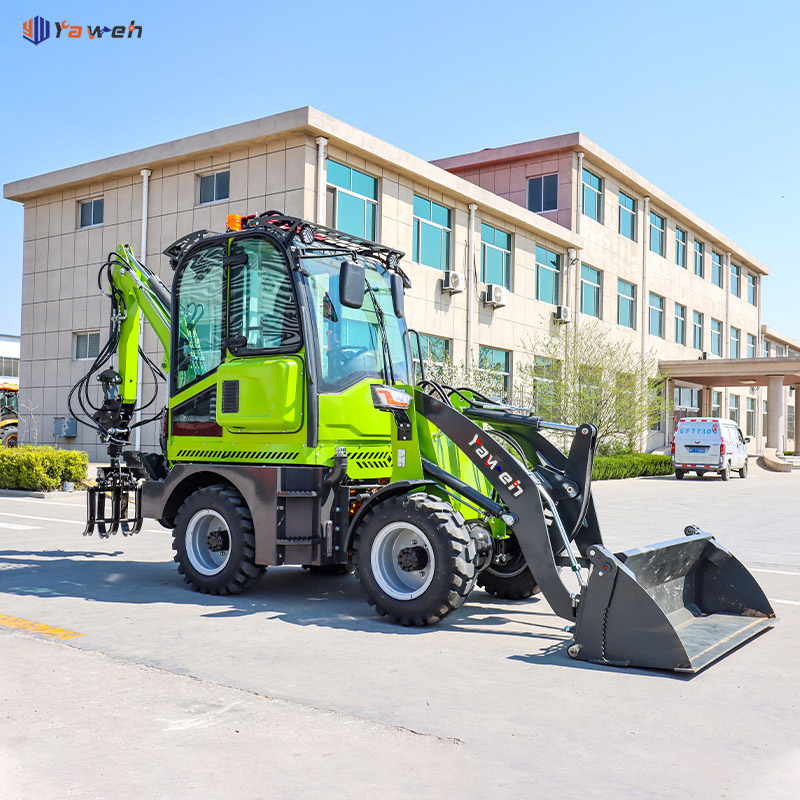
The structural foundation of a backhoe relies on a compact utility tractor chassis. It features a front-mounted loader bucket and a rear-mounted digging boom. This dual-implement setup allows operators to tackle a wide variety of tasks without switching machines. The larger displacement engines found in tractor-based backhoes are designed for drawbar pull and PTO shaft output. This contrasts heavily with the smaller, high-pressure hydraulic-focused engines of excavators.
Drivetrain configurations play a massive role in mobility. A 4x4 mini backhoe operates to provide traction across varied terrain while maintaining higher road speeds. The wheeled design allows rapid transit between job sites or across large acreages. Furthermore, the tractor platform serves as a multi-tool prime mover. The backhoe attachment can often be swapped for mowers, tillers, or snowblowers, maximizing the utility of the base machine.
When evaluating the chassis, you must look at the frame strength. Tractor frames are built to handle pulling loads. The front axle must support a full bucket of dense material like wet gravel, while the rear axle handles the torque of the digging arm. This requires heavy cast iron components and robust wheel bearings. Operators benefit from a higher seating position, offering excellent visibility over the front bucket during loading operations.
A compact excavator relies on a tracked undercarriage supporting a rotating cab, known as the house, and a front-mounted articulated boom. This design prioritizes stationary stability and continuous digging motion. Zero tail-swing (ZTS) and reduced tail-swing designs allow these machines to operate safely in confined spaces without the rear of the cab striking nearby obstacles.
The hydraulic system on an excavator is entirely dedicated to the boom, track drive, and auxiliary attachments. This focused hydraulic power allows for precise control when operating augers, hydraulic thumbs, or breakers. The tracked design distributes the machine's weight over a larger surface area, providing excellent flotation in soft conditions.
Unlike wheeled machines, excavators use independent hydraulic motors for each track. This allows counter-rotation, meaning the machine can turn 360 degrees within its own footprint. The boom itself often features an offset swing capability, allowing the operator to dig parallel to a wall or foundation without moving the tracks. This level of precision is unmatched in tight urban or residential environments.
The 360-degree swing advantage of the compact excavator makes it the superior choice for continuous trenching and spoil placement. Operators can dig, swing, dump, and return to the trench without moving the undercarriage. This uninterrupted motion drastically reduces cycle times on large excavation projects. The geometry of the boom allows for deep vertical wall digging, which is essential for laying pipe or pouring footings.
Conversely, a backhoe features a limited swing arc, typically around 180 degrees. Operators face the operational necessity of lifting outriggers, raising the loader bucket, and repositioning the machine to continue a trench. While the breakout force and dig depth relative to machine weight remain competitive, excavator hydraulics optimize digging speed and continuous operation.
| Performance Metric | Mini Backhoe | Compact Excavator |
|---|---|---|
| Swing Arc | 180 Degrees | 360 Degrees |
| Repositioning Frequency | High (Requires lifting outriggers) | Low (Tracks move independently) |
| Trenching Cycle Time | Slower due to repositioning | Fast and continuous |
| Spoil Placement | Limited to sides of trench | Anywhere within reach radius |
The distinct advantage of the backhoe lies in its front loader. It excels at moving loose material, backfilling trenches, and grading. The heavy tractor chassis and high horsepower allow a backhoe to tow trailers or pull logs. These are tasks compact excavators simply cannot perform efficiently. When clearing a site, the ability to push over small trees, scoop the debris, and transport it to a burn pile in one fluid motion is highly valuable.
A compact excavator features a front backfill blade, but its primary use is for stability during digging and light grading. It is not designed for bulk material transport over distance. If your project requires moving yards of soil across a site, the backhoe loader provides far greater utility. Excavators must rely on a secondary machine, like a skid steer or dump dumper, to move the spoil pile away from the digging area.
Tracked excavators distribute weight over a larger surface area, reducing ground pressure and preventing rutting in soft mud. This makes them ideal for wet site conditions. Their low center of gravity also provides superior stability on hilly and uneven terrain compared to the higher center of gravity of tractor-based backhoes. When working on slopes, the excavator operator can position the tracks up and down the fall line, using the blade as an anchor.
Wheeled machines excel when traveling long distances across a large property. They do not require a transport trailer to move from one end of a farm to the other. They also cause less damage to paved surfaces, making them suitable for residential driveways and road maintenance. However, heavy wheeled machines will sink rapidly in saturated clay or deep mud, requiring a tow out.
Daily farm operations require moving feed, clearing brush, and maintaining irrigation lines. A 4x4 mini backhoe for farm use provides immense utility by transitioning rapidly between loader work, like moving hay bales, and rear-hoe work, like digging drainage ditches. Farmers need a machine that can handle multiple attachments, and the tractor base delivers exactly that.
Using a 4x4 mini backhoe for livestock farms proves highly effective for mucking out stalls, managing manure piles, and repairing fencing. In these scenarios, a dedicated excavator would sit idle for long periods. A compact excavator on farms often requires a trailer for long-distance movements between pastures, reducing its daily efficiency. The backhoe can simply be driven down the county road to the next field.
Residential contractors and homeowners face confined property lines, existing turf preservation, and varied daily tasks. A 4x4 mini backhoe for garden work allows operators to haul mulch or gravel with the front bucket while using the rear hoe for planting trees or installing retaining walls. The ability to carry pallets of sod or block with front forks adds to the machine's landscaping appeal.
However, a mini excavator demonstrates superiority in tight backyard access. It easily fits through standard gates and performs precise foundation digging close to structures. The tracks minimize turf damage when turning, provided the operator uses care. For installing irrigation systems or small water features, the excavator's precision prevents over-digging and reduces manual shovel work.
Utility installation requires linear trenching speed, precise depth control, and the ability to work alongside active roadways. The compact excavator remains the industry standard for these specific tasks due to uninterrupted cycle times and a compact footprint. It allows crews to dig efficiently without constantly repositioning the machine.
Mark the utility line path using marking paint and flags.
Position the excavator parallel to the trench line.
Engage the front blade into the soil for maximum stability.
Begin trenching, swinging the house to deposit spoil on the designated side.
Track backward smoothly as the trench progresses, maintaining depth control.
Comparing the operational value reveals an interesting dynamic. A premium tractor-loader-backhoe setup often replaces the need for multiple machines. Budget, direct-import mini excavators enter the market as single-purpose tools. While a dedicated excavator excels at digging, it forces the operator to find alternative methods for material transport and grading.
Budget imports come with trade-offs. Poor parts availability, lack of local dealer support, lower hydraulic flow rates, and lower resale value plague off-brand machines. A backhoe often negates the need to acquire a separate utility tractor or skid steer, offering strong consolidation value for independent contractors and property owners.
Mini excavators burn less fuel on stationary digging jobs because their engines are optimized for hydraulic flow rather than continuous drivetrain travel. Backhoes provide better value on expansive projects where material transport, driving distance, and loading tasks are mixed. Idling an excavator while waiting for a dump truck wastes fuel, whereas a backhoe can actively load the truck itself.
Transport requirements differ significantly. Backhoes can be driven directly between adjacent sites. Excavators strictly require a heavy-duty trailer and tow vehicle. Maintenance complexity also varies. Backhoes have two sets of loader arms and a wheeled drivetrain to maintain, whereas excavators have complex undercarriage track systems that require tensioning and eventual replacement.
Backhoes require operators to switch seats and manage two distinct control schemes. Excavators offer a unified, joystick-driven experience that is often faster for novices to master. Wheeled backhoes can cause severe rutting in wet conditions. Mitigate this by scheduling heavy transport during dry periods or opting for a tracked excavator if the site is perpetually soft.
Using a backhoe near existing structures carries a higher risk of collision due to the fixed chassis position and swing radius constraints. Mitigate this risk by measuring site clearance before equipment selection and ensuring operators understand the machine's physical limits. Always use a spotter when swinging the boom near residential siding or overhead power lines.
Audit your projected task list carefully before acquiring heavy equipment. If the job is heavily weighted toward digging, trenching, or working in confined spaces, the excavator is the logical choice. If the job requires material moving, towing, and diverse tasks across a large acreage, the backhoe provides superior utility.
Evaluate your site terrain to determine if tracks or wheels are required for safe operation.
Calculate the percentage of time you will spend digging versus moving loose material.
Measure all access gates, pathways, and overhead clearances on your typical job sites.
Secure a short-term rental of both machine types to test on actual site topography before committing to a long-term acquisition.
A: Tracked mini excavators are generally safer and more stable on hilly terrain due to their low center of gravity and continuous track traction, whereas wheeled backhoes have a higher center of gravity and risk tipping if operated parallel to a steep grade.
A: While a backhoe has a front loader that can move material similarly to a skid steer, it lacks the zero-radius turning capability and high lifting capacity of a dedicated skid steer, making it less efficient for continuous, heavy material loading in tight spaces.
A: Tractor backhoes are built on a complex utility tractor chassis containing a high-horsepower engine, heavy-duty transmission, PTO, and three-point hitch systems, alongside two separate hydraulic implements, whereas a mini excavator has a simpler, single-purpose hydraulic drivetrain.
A: Mini excavators typically burn less fuel on small, stationary digging jobs because their engines are optimized for hydraulic power rather than drivetrain travel. Backhoes may consume more fuel if constantly repositioned.
A: It depends on the combined weight of the tow vehicle, trailer, and equipment. Many compact excavators and backhoes fall under the 26,000 lb Gross Vehicle Weight Rating limit, but you must verify local regulations based on your specific hauling setup.


